Showing posts with label sketchbooks. Show all posts

Monday, 7 March 2022

Sketchbook: The Early Flowers (and their stories)

We're already into the third month of the year and spring will be upon us soon, so, it's time for a quick sketchbook update following on from my previous blog post. This year I don't have time to make a sketchbook page every week, but want to keep momentum with recording plants and fungi and aim to complete one at least entry every other week. The project has now come full circle and I'm seeing the plants painted last year back in bloom, this is definitely driving me forward with the project. Sticking to native and naturalised plants makes it slightly more challenging but there is really no shortage of plant material available at this time of year, here are some of the plants and one fungi illustrated between January and early March this year, but I begin with a look through the book in this short video clip. 

Below is a little about each entry because I can never fit enough information on the sketch pages. Each subject usually has at least one fascinating fact, including medicinal uses, pollination strategies, animal plant interactions, symbolism and folklore, food sources and much more.  
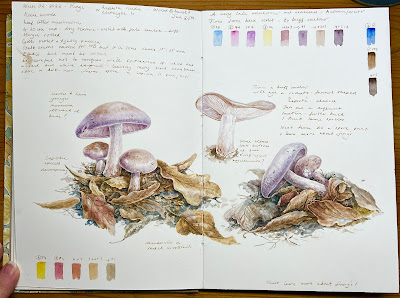

 January 25th, my second entry for the year was the Wood Blewitt, Lepista nuda

Found at Keele woods, which is on the site of the University where my daughter is a student.  I've made a few studies here before and there are some interesting plants and fungi which I hope to record in the future. The Wood Blewit is one of the latest mushrooms of the season which was unexpected in January,  the colour is a very attractive blue/ lilac and apparently they are a gourmet mushroom that appear through the leaf litter, this made a nice setting against the violet colour.  I'm  not overly confident in my identification skills of fungi and won't be eating these mushrooms any time soon as they are very similar to several poisonous species, such as the Cortinaruis fungi. Whilst scanning the surrounding area, as all nature artists do, I was also excited to spot a Medlar tree next to these mushrooms.  Note that I switched to using walnut ink here for the notes.....hence the top left splodge! 


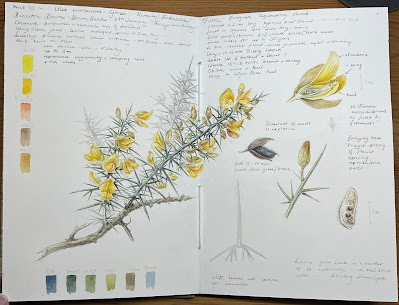
 January 29th,  the third entry of the year was Ulex europaeus, the common gorse (family: Fabaceae), also known as Furze 

These very common plants were found at Barlaston Downs, which is a national Trust woodland and heath, just a couple of miles from home. Gorse is a beautiful plant with a perfume of coconut, it always reminds me of my time living in Scotland and I can recall seeing the Yellowhammers flying in and out of the bushes, which surrounded my house. 
I always like to find out about medicinal or other uses for plants and Gorse is no exception, as an important plant in identifying the rare blood type known as the Bombay or HH or Oh Phenotype, first identified in Bombay in 1952. It turns out that Ulex europea contains Lectin in the seeds, which binds to 'H' substance in red blood cells. 
Most people will never know they have this blood type unless they are unlucky enough to need a blood transfusion. Individuals with this blood type are deficient in the H antigen, this is the antigen found on all red blood cells which is the precursor to the production of all other ABO antigens. As a result those with the Bombay phenotype may appear to be type O, however they carry an extra antibody which makes then them incompatible with the O blood type because they lack the precursor antigen known as 'H'. Thus they can only receive blood from other H deficient blood types, giving them a transfusion of another blood type will cause a very severe reaction. With only 0.0004% of the population having this blood type, it's pretty rare, so gorse has been instrumental in ensuring that those with the Bombay phenotype are identified and not given the wrong blood type. 


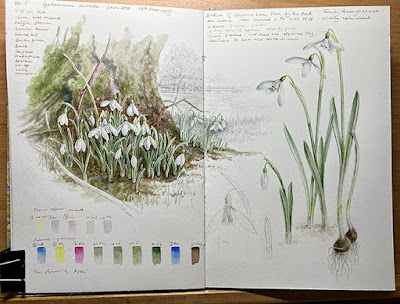
February 17th Galanthus nivalis, the common snowdrop (Family: Amaryllidaceae) 

These milk white snowdrops grow at the bottom of the lane where I live. It's not  a native plant but one that became naturalised and is thought to have arrived in Britain in the16th century. Although I try to complete pages in the equivalent of one day, this one took longer and I moved on the the next and returned to it over a week later. The idea of backgrounds is appealing but have to keep in mind that it's more time consuming.

The snowdrop is known as the plant of hope, simply because they signal the first signs of new growth in advance of spring but it also offers other hope to Alzheimer sufferers. This plant that has important medicinal uses, snowdrops contain the alkaloid galantamine, which is approved for use in the management of Alzheimers disease in over 70 countries, including the UK. The anecdotal use of the snowdrop in medicine has long been recorded and Greeks first acknowledged the effects of galantamine in Homer's Odyssey, when Odysseus used the snowdrop to clear his mind of bewitchment. In modern medicine galantamine was reportedly first extracted in the 1950 after a curious Bulgarian pharmacist witnessed the use of snowdrop leaves and bulbs being rubbed on the forehead of villagers, it was noted to be a chemical of importance in cerebral function. Galantamine was approved as a drug in Bulgaria in 1958 and in the US in 2001, it acts as a treatment for memory improvement for those with Alzheimers and mild dementia. 


February 20th, the fifth page of the year is Eranthus hyemalis or Winter Aconite (Family: Ranunculaceae)

These little plants were blown clean out of the ground during storm Dudley, which followed two other nasty UK storms. It was an opportunistic find when I saw them lying on the ground and gathered them up, they made a nice interval to painting the snowdrops. Winter aconite is another naturalised species first recorded growing wild in Britain in the 1830's although introduced in the 1590's. 
 It's a poisonous plant if consumed, although not as poisonous as Aconitum which it was at one time erroniously classified alongside because of its leaf shape, it is however in the same family, and all Ranunculaceae are poisonous to some degree. It contains some useful medicinal properties with the chemical khellin, this is a toxic chemical that acts as a vasodilator but can be converted into a harmless sodium chromoglicate used as a prophylaxis for the treatment of asthma attacks. Also amiodarone which is used for atrial fibrillation and arrhythmia treatment.

A Final Thought: Why are so many early flowers white or yellow?

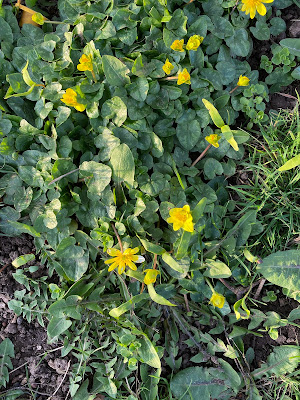
you may have noticed thet many of the available UK native flowers at this time of year are white or yellow and quite small, which makes them challenging to paint, the inclusion of backgrounds or habitat can be useful when painting such colours because it makes them stand out. This approach is not completely unrelated to the existence of these pale coloured flowers in nature.  
In fact one of the reasons commonly cited in the prevalence of white and yellow flowers is related to the generalist pollinators, which tend to be small flies early in the year, these flies have an innate preference for white and yellow and with their dichromatic vision it's easier for them to spot the flowers against the dark background of foliage or the soil beneath them, so pollinator preference is believed to have driven the evolution of early white and yellow flowers. 
There are of course many other reasons why pollinators prefer certain plants and it's a pretty huge subject to delve into, so I won't go any further with it for now but will no doubt touch on pollinators and flower preferences in the future. 

My next sketchbook subject is also a yellow flower and another from the Ranunculaceae family, it's Lesser Celandine, Ficaria verna, which is just coming into flower. This plant is known as pilewort, for medicinal reasons which you can no doubt guess! 


This sketchbook project is a continuation of the botanicalsketchdates project which began in February 2021 with my friend from the US, Debbie Crawford.


Sunday, 20 March 2016

The Sketchbook Exchange Project, Work Resumes

Last week a box containing three sketchbooks arrived on my doorstep. These books belong to other artists involved in the Nature Sketchbook Exchange Project, which I've been involved in since 2014. The project stalled a bit last year, so it's great to get started again. Check out my last post on the project to find out more about it and also the project blog to see the wonderful work by the other artists. Here's are a few of my latest entries, I'm currently on my 12th book.

A selection of my sketchbook paintings
The Stillman & Birn Sketchooks, I currently have four books....two down and two to go!

It's always exciting to open the books to see what treasures are inside! Seems like a long time ago when we started this project but there's no rush or pressure with this project, which is what makes it so enjoyable. I can't wait to get my own book back at the end of the project.

An image of my sketchbook drawing
Looking forward to seeing what's inside my own sketchbook when it returns later this year, seems like a long time since this drawing in 2014
The last few books have been completed over the winter period and their contents reflect this time of year. My most recent entry is in the book belonging to one of my favourite artists, Aislinn Adams, from Oregon. I chose to paint tree seed pods during a trip to Barcelona last week and spent approximately one day on this entry. I seldom spend more time than this on any one entry, so this makes these exchange projects very achievable...they don't need to be masterpieces but a more relaxed approach in style and most of all they're fun to do.
 
Seed pod sketchbook painting
Collection of Tree seed pods from the park in Barcelona, a mix of graphite and watercolour

Maple seeds drawing and painting
Detail of watercolour and graphite studies of maple seeds
In November last year I started an entry in Ida Mitrani's book, I chose a collection of leaves from outside my flat, but I wasn't at all happy with this so kept the book until after Christmas and opted to complete a second entry, a 2 page spread of an Iris foetidissima seed pod, found in my local park.

leaf paintings in a sketchbook
Not terribly happy with this effort, so opted to complete another page in Ida's book.

Iris foetidissima seed pod watercolour
Iris foetidissima seed heads, my second attempt
I always paint directly on to the paper for my entries rather than gluing work in, some sketchbooks have pretty poor paper but the Stillman & Birn books that we have all used are great so there's no need to work on other paper, plus I've grown to like the idea of painting in another artists book.....there's an element of fear of messing it up but this also means that it's you can't make a mess. But if it does go a bit wrong, it doesn't really matter, it's part of the process. It's onto book number 12 next, which belongs to my good friend, Debbie Crawford....maybe I'll paint some flowers now that it's officially Springtime here in the UK.

If you've never been involved in such a project or don't keep a sketchbook, I really do recommend it!


Next week: I'll be writing a review of the two new watercolour papers from Saunders Waterford and discussing the changes to Fabriano papers.

watercolour exercises testing papers
Next week! Testing old and new papers, using a variety of watercolour techniques

Monday, 5 January 2015

Out with the Old and in with the New Year

Having woken up on New Year's day with the cold from hell, I was feeling more than a bit sorry for myself. But there's always an upside to everything and being confined to the armchair provided a good opportunity to reflect and plan for the year ahead,  and, to do a bit of sketching.

Let the sketching begin! Crow skull, graphite on Stillman & Birn Zeta sketchbook paper, life size. 

Initially I thought I hadn't achieved all that much with work over the last year but making a rough plan at the beginning of the year and reviewing it at the end is very useful.  I won't be beating myself up too much about the 'incomplete things' - it was a hectic year! Life events tend to drain energy, time and money but things settled mid November 2014 when I finally started to put down some roots again. Now that I have somewhere to work and the Festivities are dealt with the time has come to get stuck into some serious work but I feel the need to warm up first with some sketching. In fact sketching has been elevated to the number one activity in my New Year resolutions! 

Roe deer skull, Graphite. Life size study A4 Stillman & Birn Zeta Sketchbook. Completed using the hatching.
The sketches don't necessarily have to be botanical and it's sometimes better if they're not - other subject seem to help me to loosen up the drawing style. I made a start on some old skulls, they're very good subjects, as are seed pods and shells, dead insects etc. .... you see they don't move or wilt! The aim is to work fairly quickly on these sketches, always from life .....and done on a regular basis. Sketching and tonal drawing is all important,  and a botanical painting is pointless if the drawing is off and the tones aren't there.  My daughter, Polly, is home from University too so she's been joining in and yes she's got a blog too!

Looking Back
Having had a good think about last year and looked at the positive things as well as the things I could have done differently it's not been so bad!  I'd forgotten half of the things so trawling through the blog made me realise that more has been achieved than I originally thought.
 Painting and drawing is my job. I teach people, sell original work and illustrate all sorts of weird and wonderful natural things, from rice packaging to the internal structure of a bony fish! It's a notoriously unstable and slightly chaotic work choice, particularly if you're a solo act. Sometimes it's hard to make the best decisions because I'm torn between what I want to do and what I have to do but wouldn't change it for anything else in the world. This career choice means that I have to work hard, plan well and be organised. It's not just about painting either, there's some serious multi-tasking including, promotion, websites, book keeping etc. etc.
RHS Show Orchid Show in April at the Lindley Hall. Great fun but unprepared!  Photograph courtesy of Alena Lang Phillips
Last year I wasn't terribly organised when I committed to the April RHS show, I had applied for the October, Shades of Autumn show - but for some unknown reason I ticked the box selecting the London Orchid Show as second choice.... That was my first mistake! Never put a second choice if you haven't got time! I've done 5 RHS shows since 2004 and always applied for London as first choice but never been allocated it, so felt I had to do it when it finally came my way. 


Behind the scenes the frantic preparation! before the plants die

 Other work commitments meant I was left with just a few weeks to paint 6 works on vellum...it wasn't the best idea but it was 'do-able' if I kept it small and simple. That was a criticism by judges, they wanted more like this one, and less of the simple studies. It went a bit wrong at times and I didn't have time to present them properly either, but I got them all finished and made it to London. I have since done a bit more work on some of them and mounted and framed the the unsold ones. 

Fritillaria meleargris, exhibited at the London Orchid show
It was a great experience and I enjoyed it enormously, met lots of lovely people, many of who I've only ever communicated with via email. I was awarded a Silver and sold two of the paintings but I know that more time is needed to prepare for such high profile show and so I learned from it. Long term planning is the key and it's something I need to refocus on after the upheaval of the last 2 years. If I ever apply again I'll prepare the paintings and then apply for space when and only if I'm happy with them.
 
From the Royal Brompton and Harefield Exhibition flier


I also managed to exhibit 16 paintings at the Royal Brompton and Harefield Hospital Trust with my good friend Julie Whelan. A fantastic opportunity, thanks to Julie. Arts in hospitals is a great initiative, it brings a diverse selection of work into the hospital environment for the benefit of both patients, visitors and staff, and, with commission going to a good cause! We dropped off the paintings at the hospital and were given a tour of the old world famous Harefield, they have some super work in their collection including a beautiful urn by Grayson Perry. The paintings went on to be exhibited at the Royal Brompton until November.

Planning Ahead 2015
The new workspace is sorted and reasonably comfy,  so I'm ready to roll! I've had a clear out of materials and invested in some big vellum skins and other materials.....so no excuses for slacking! This year I want concentrating on more complex works in graphite on paper and watercolour on vellum ( although I reserve the right to change my mind at any point).  Here's a bit more drawing practice underway.... just! I drew this rather complicated rough composition of bindweed during a trip to Germany in the late summer, decided to dig it out today as practice. I have to work from photos and some dried specimens, not my favourite approach but I want to finish it. Hmmm....it's going to be quite challenging!

A bit more drawing!
......do you ever wish you hadn't started something! I'm working on Arches HP, size 18 x 24 block. I like this paper for graphite work but not for watercolour. It took an age to plan the composition but it will no doubt take much longer to complete. I can 'chip  away' at it when I feel like it tough as I'm only left with photo reference and a few dried specimens now. Who knows it may well run into the next flowering period!
Fortunately I took hundreds of photos! and captured quite a few mini beasts

.....and collected dried bits of the same plant from behind the shed at the bottom of my daughters garden!...I trod on a nail to get this!
Basically I want to keep drawing and painting this year to make up lost ground. Sounds obvious but putting together a body of work that I'm happy with is important, it won't be for any particular purpose, no specific exhibition or show and I'll decide what to do with it when it's complete. I won't be working to anybody else's criteria. Something to plod on with in the background and with the subjects I choose.

The Exhibitions Calendar ... OK what's achievable? 
I'm spending time researching the exhibitions calendar for the next few years. I hope to submit work for this years SBA Annual Show, In Pursuit of Plants. 
It's 3 years since I last did the SBA show and I aim to submit just one large piece on vellum.
 
Back in May I wrote about the Jade Vine painting. I'm almost ready to send off the digital image this month for the Sydney Florilegium Exhibition, which takes place next year at Royal Botanic Garden, Sydney.  I've worked on this over a two year period after tracking down the plant at Kew and Durham Botanic Garden.

I visited Kew to observe the amazing jade vine earlier this year. 

Work in progress. The finished painting will be scanned and sent as a digital image at the end of Jan, that's for the for printing. The original will be packed off to Australia shortly afterwards.

Teaching and Websites
Over the last few years I've written a number of online courses,  it's great fun and I have some lovely students. It's a constant learning curve for me as well as for the students and it's important to learn from their feedback. The materials are delivered via a dedicated course website, which I constructed and manage and we have a private Facebook group too. This year  I'm undertaking some new materials on Composition as well as adding to existing courses and developing things a stage further.....gotta keep up with the technology!

A video still from the  Botanical Watercolour Course
 My method of teaching, I hope, looks at the fundamental techniques and theory behind drawing and painting for the botanical student. It's not an 'easy option' approach and requires hard work but I believe it's an approach that will give students the building blocks that they need to develop their own style and to work independently as artists in their own right beyond the course. 

A still from the Course website


Blogging Birthday Ahead!
On Jan 18th I will have been writing this blog for 6 years! There have been some gaps over this period,  initially it felt like a bit of a waste of time - there seemed no way of finding others with the same interest but the amazing Sigrid Frensen found me and was thinking along the same lines. Sigrid had started a Botanical Art Facebook group, which I later joined as co-admin. It now has over 2000 members! So the whole Botanical digital world has grown enormously in the last few years and it's much easier to find people, and, there are now lots of amazing botanical art blogs to read. Writing the blog  is something that I really enjoy, hopefully others find it useful too and it's a brilliant way of keeping a diary for me..... I'll need to think about some way of celebrating!

Continue with the Sketchbook Project 
See my previous blog post. This time next year the project will be coming to an end and I'm very very excited to get my book back!

Finally... see more of the World and Exhibitions
One of the things I've pursued this year is travel, something that I hadn't really done a lot of up until a couple of years ago.  I've seen lots of exhibitions, including most recently the Picasso Expo in Brugge, also the Dali exhibition.  I've visited many galleries at home, looking at a wide variety of styles, from the fantastic Shirley Sherwood Collection and Marianne North at Kew, to Andy Warhol at Tate Liverpool and Turner Prize winner Martin Creed at the Hayward. It's something that has been invaluable.....diversity is definitely good for the mind! Travel has also given me the opportunity to draw and sketch plants away from home and in the field. Here's one from earlier in the year from a trip to Switzerland, Austria and Germany.

Linaria vulgaris, sketches
 I'm travelling to Donegal in a couple of weeks so will see what I can find there to paint....there's always something to paint no matter where you are, whether its from the back garden or further afield.

That's about it for 2014 and the rough plan for 2015!