Showing posts with label nature journal. Show all posts

Friday, 9 February 2024

Sketchbook Update and a New YouTube Channel

It's well into February already and the sketchbook continues to grow,  I haven't  updated for quite some time, probably since the final entry in book 2, which was June 2022! So here goes with the story up to date. I'll begin with my latest page, which was a little different for me, then I'll tell you about my new sketchbook channel and share a few images from last year. 

My latest entry from January 26th 2024. I had to ask myself why I didn't draw this beautiful oak tree before... the answer is that sometimes the obvious things can be 'too close to home' to see, and this reminded me that there is no need to travel the earth to find special things. that said, my underlying interest in drawing the whole tree probably came from painting the autumn oak branch for the Irish Society of Botanical Artist's, Irelands Native tree exhibition, which was held in October 2023 (image below). I've drawn a few trees or partial trees in the past few years and ventured into drawing trees through keeping a sketchbook.

The featured tree is the largest of three oaks (Quercus robur) that can be seen from my window,  the age is unknown but after a chat with the landowner, the assumption is that it must be 200 years old, maybe more  ... but now that it's stirred my interest I want to know more. That's the other great thing about keeping a sketchbook, you become invested in the subject, you build a relationship and when it's so close to home you can document it throughout the year. There are many oaks around here, including ancient ones at Trentham Woods. Many of the ancient oaks in Britain were planted by landowners for the purpose of ship building, the most famous ship being the HMS Victory, built in the 1700's it is said to have been built from 600 oak trees! The ships survival  is testament to the strength of the oak timbers.

Pencils used in the Oak drawing: from left to right, Rotring 600 0.5 mm HB, Faber Castell TK- Fine Vario HB 0.5mm, Faber Castell clutch TK 4600 HB, and 2B (2mm lead) and Faber Castell 9000 HB - 2B.  It's a fairly loose drawing, so I kept the range of pencil grades fairly small but if I was making a final larger drawing I would use a wider range, probably 4H to 6B.   

This page is mostly graphite page and gave me an opportunity to play with a few different pencils. I used the good old Rotring 600 mechanical HB grade for the outline and smaller branches, I do love the weight and balance of this classic Rotring pencil, it suits me and it's beautifully engineered, its more expensive than most mechanicals but the mechanism seems very stable, unlike others which break with heavy use. I also played with the Faber Castell TK-Fine vario, which is and unusual mechanical pencil because it has a hard and soft setting, the soft setting is sprung so that eases pressure on the paper for the heavy handed. I'm not sure it really took off as a concept and got a bit of bad press but it's a novel idea, and I like novel ideas. For the tonal work I used the trusty Faber Castell clutch HB and 2B 2mm leads, which always do the job and a few FC 9000 wooden pencils. I'll write more about other pencils in a different blog post.I added the budding branches with an enlargement in watercolour for additional info about the tree at this time of year, and a little colour lifts the page

.   

Here's the tree alongside its two smaller neighbours, note the photo distortion at the outer edges of the image, which has greatly enlarged and distorted the right side of the tree, this is the reason why these things shouldn't be drawn from photos. I'd like to write more about the perils of photo distortion... but there's no time just now, sometimes we have to use photos to support work but drawing should be from life. 
Below is a detail from the Autumn oak branch painted for the ISBA exhibition October 2023 


My other news is about the new YouTube Channel, which I launched late in 2023.  This channel is dedicated to the sketchbook and is titled, the Botanical Sketchbooker. It's a simple concept, which I wanted to make easily accessible and free, so YouTube is as good a place as any. I do hope to encourage others to sketch from nature and their local surroundings, basically it's just me sharing what I do, my materials, practice, plants and thoughts on the process. There are a number of amazing artists who keep similar books of their native plants and I love them all. 

BUT remember that you can do whatever you want in your sketchbook, it's entirely driven by your own interests, it can be native plants, flowers in your garden, houseplants or even the things that you've been collecting in a box or on a shelf, such as dried seed-pods, leaf skeletons and branches etc. There is no award, certificate or market to bow to with this activity, it's just for you and that can feel quite liberating! (probably the take home point here). 

The sketchbook channel is new so you won't find lots of content yet, it's a bit of a slow approach and to be honest, sometimes it feels a little awkward to share my personal sketchbook but I'm sure that I'll grow into it. On the channel talk is about materials and practical things but also about plants, choices, reasons  and general thoughts on nature.   


My first page for 2024 began January 20th, it includes some found things, a lichen encrusted branch, a tuft of mossy bark 
and an old crow's skull, that's been sitting on the windowsill forever! This was great to do at this time of year because it can be completed from the comfort and warmth of my desk... I'm a fair weather person and trailing around in the cold isn't for me! I do like to start early in the morning though and the thought of a good sunrise is alway motivation. Morning is definitely the most productive time for me but I don't impose any rules on when and where I should complete my pages, so occasionally I'll work into the early hours of the morning, the only broad rule I have is not to spend much more than a day on the pages but this can be split across two days.  
 
The branch in this page was blown my way by recent storms and this page followed on from a previous page of broken twigs, painted in December, which you can see further down the page. As you can see I dropped a second branch behind the main one but painted it in lightly, so using aerial perspective which is useful when trying to create depth and separation, whilst creating a little more interest, the branch looked a little too stark without it. 

I strongly belive that the sketchbook is good for an my development as an artist, it improves  observation, allows me to learn more about plants, to experiment with approaches, techniques and composition and importantly I feel it is good for the mind.  The plants that I paint are chosen for the simple reason that they capture my interest and make me think about my surroundings..... and how wonderful nature can be. Often I discover something completely new that amazes me and usually read about each subject in the evening.  Most recently I've been adding information about the weather which is very relevant considering that all of the twigs and branches in my recent pages arrived courtesy of the January storms. Comparison between years between weather, flowering times and conditions can be very useful over time and provide an important snapshot of our local environment - such sketchbooks books could even turn out to be a valuable ecological insight in years to come

Beginnings, pencil sketches and working on each branch 
Four twigs: December 23rd 2023: I had been in Paris for a few days and delayed home by storm Pia, when I finally arrived home  an array of material was scattered on the Lane to choose from, So I chose the most diverse selection of twigs. Ash with moss, the second one I was unsure what it was, but it had a large lichen, third was the dark was hawthorn with the wet bright green lichen and finally a silver birch, these poor trees were pretty smashed ups by the storm. 

The seasonality here in the uk is always a reminder of time ticking away as is the blooming of any plant,  my advancing age is certainly changing my perspective on what's important. For years I worried about whether I was painting the right subjects, and contemplated whether I should paint more commercial subjects, like big flowers or maybe should try a different medium, eventually I just settled into my own skin and found that the things I love, which are reflective of my interests, maybe they're not so commercial but I've actually found that much paid work came my way from the sketchbook too, and that was a surprise, so doing the things that you are passionate about can pay too if you are consistent, lets face it we all have to earn a living and and committing to being an artist isn't always easy.

 The past few years of sketch booking, I have enjoyed it immensely and feel very fortunate, I am forever grateful to my dear friend Debbie Crawford who suggested that we should have a weekly sketch date during the Covid pandemic, that's when really indulged in the book, in more recent years, as things returned to normal, I have time for a weekly entry but try to create a page every couple of weeks, sometimes I'm too busy with other work but that's ok too...and I always look forward to getting back to my book.  Below is a seasonal selection from 2023, I picked one to represent each month here.


November 2023 Mistletoe

October 2023  Fly Agaric 

September 2023, Wild Strawberry

August 2023, Scots Thistle

July 2023 Wild Raspberries


June 2023, Flag Iris 

May 2023, Creeping Buttercup

April 2023, Forget-me-Not


March 2023, Goat Willow


February 2023, Cyclamen coum

January 2023, Ash tree, back to trees again at the lean times of year

One other thing that's worth a mention is artists block. A times artists can be afraid of the white paper and the quest for perfection dominates, yet this only seems to hold us back, maybe my perception is wrong but being a 'perfectionist' can make it hard to actually get anything finished or even started because of this self-inflicted pressure - but that pressure can also come from over-thinking what you 'should' be doing as an artist.... I've been there. Not everything has to be perfect, not everything will be perfect, it goes wrong, its normal, its part of the process of learning and learning never stops. Not that much helps when we feel that way and sometimes I think a pause can be part of a process of re- emergence.  

Today pressures are different than they used to be, yes we are more connected but also spend a lot of time alone, endless scrolling of social media can at times be off-putting, especially if we make the mistake of comparing ourselves to others. Don't get me wrong, I absolutely love social media and think it has transformed the artists' world making the globe a much smaller place. In fact if it wasn't for social media I wouldn't know Debbie or all my other botanical friends and neither would I have such an effective means of communicating, for me it nurtures ideas, its like a giant library, but only if you look in the right places -  on the downside, constantly seeing the progress of others when we're feeling a little low on inspiration, with daily reminders of successful memberships, certificates, awards, accolades and being accepted into exhibitions, can make us feel like we are failing and it's depressing for some. Being or feeling rejected can feel harsh and defeating. Of course all of these thing are just what happens, and rejection and failure is also part of the artists life, but feeling unsuccessful or not as good as others can  contribute to creating a block. In addition, life can throw in other challenges, such as health or relationship problems, this means it's not always possible to achieve what we want, sometimes we fail, at these times the sketchbook can be an amazing safe place to retreat and reflect. 

And so, although a sketchbook may have no obvious or instant reward in material terms, it may seem even pointless to some (yes I've heard that before) it can be surprisingly rewarding with much to be gained and it might surprise you what can come from it. 

Thanks for reading, having returned to my blog again I see there have been over 1 million views! I suppose it's not a lot as blogs go but I guess people are still reading....so thank you. I will try to write more. 


Sunday, 6 November 2022

Sketchbook Update, March - June 2022

My last update was early spring, so it's time to add more about the sketchbook. I've not completed so many pages this year but that was expected as we come out of the pandemic, and, with other work to do it's a big ask to complete a page every week.  The aim this year was a page every two weeks, which is achievable, given that  23 are completed to date. There are too many for one post so will do this in two. So here goes with March to June, entries 7 - 13: 

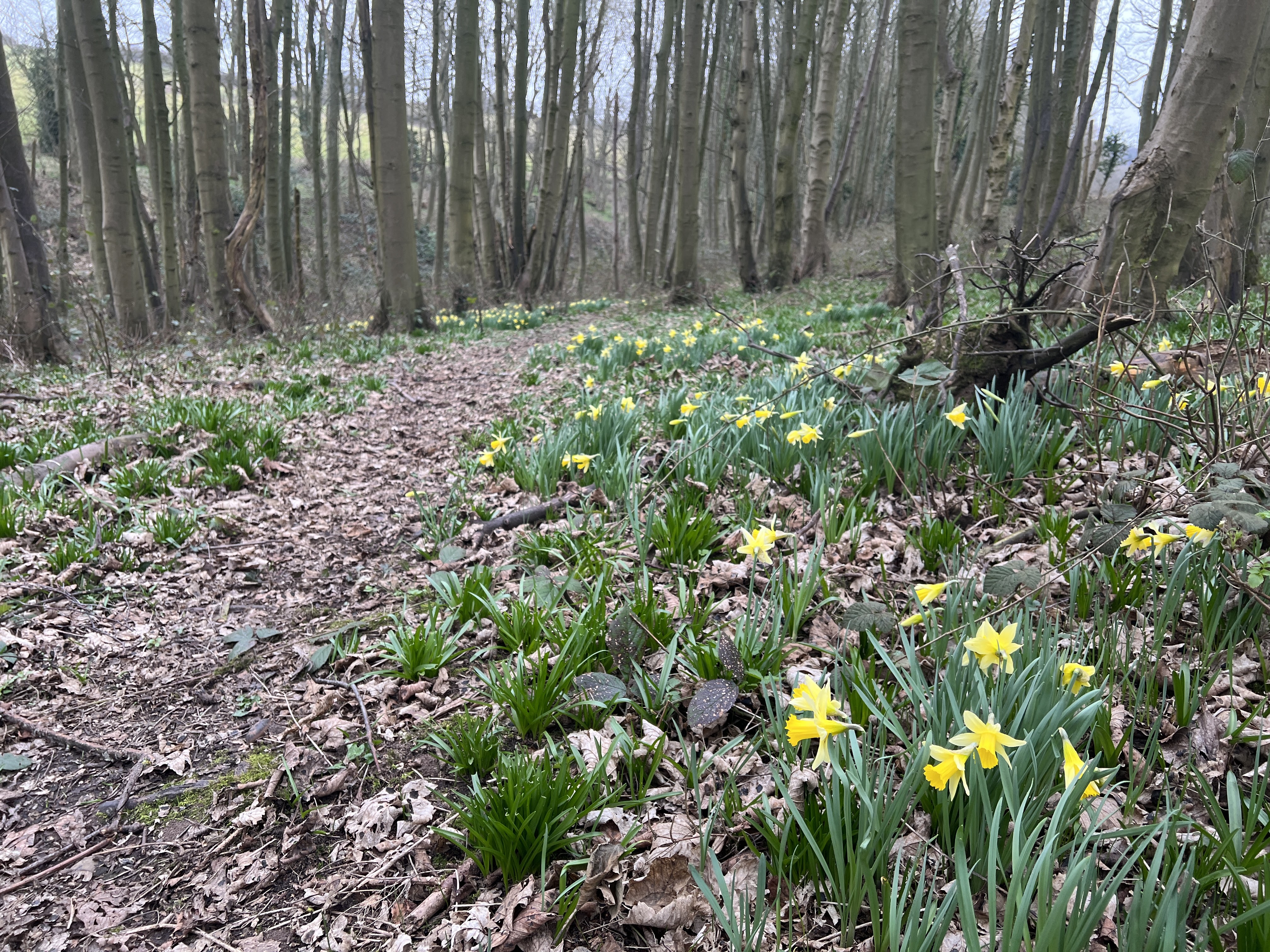
I left off in the last post with the promise of Celandine for entry no. 7, and it was indeed completed, but I completed another painting first, it was the wild daffodils at the ancient woodland  at George's Hayes, Longdon,  Staffordshire. It was March 11th and the day before my 58th birthday, so thought I'd take a bit of a trip out. A bit of a rushed page painted in situ because it started raining.... so that was the end of that. 

Narcissus pseudonarcissus, wild daffodil at Georges Hayes Wood. March 11th  2022

Beautiful sight and the largest stand of wild daffs in Staffordshire 

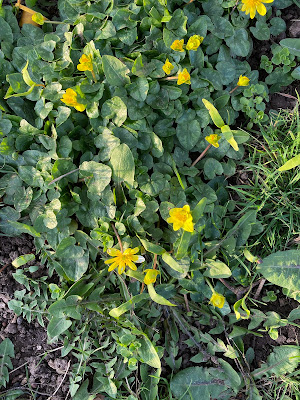
No. 7. Heres the Lesser Celandine, yes yet another yellow flower. This was early April and at that time of year Celandine is everywhere. 

Ficaria verna, Lesser Celandine April 2nd 2022
Roadside down the Lane in Checkley, my old stomping ground

No. 8 Next up, its yellow again! with Cowslip. I planted this on the edge of the garden and it's doing well this year, I also had a few in pots which is always handy, it was a lovely sunny day so I sat out and drew it, then finished it off indoors, because it was way too bright outside. It seemed complicated to draw but was much easier than I thought and took about an hour. I try not to spend more than one day for each page but often this is split into and hour snatched here or there.  

Primula veris, Cowslip. My garden, April 2nd 2022


No. 9 Spot the odd one out, not a British native plant for the next page because I took a holiday to Malta! and of course the sketchbook came too. I have to paint this gorgeous little Barbary iris. A walk to the cliffs at Sannat in the morning, revealed the presence of the dead long leaves, like little snakes but the flowers don't open until later in the day, it was extremely hot and a swarm of tiny flies descended, which filled my hair, eyes, nose and clothes...its was pretty awful but didn't stop my return later that day to paint this little beauty. 
Morea sisyrinchium, the Barbary Nut, Sannat Cliffs, Malta, 25th April 2022 


See how tiny it is! 

No. 10 Back home again and back to dandelions, I became slightly obsessed following the realisation  there are so many species. This one was at the SSSI at Allimore Green, Haughton, Staffs. I think its Taraxacum faeroense, very cute little dandelion. 

Taraxacum faeroense, Allimore Green SSSI Haughton, Staffordshire, 8th May 2022

The bracts are all important in identification


Allimore Green, a rare piece of land the wasn't drained and has been preserved that way, a designated SSSI 


No. 11 Another dandelion,  one from the Hamata section I'm told, T. lamprophyllum, it seemed too small but that's not always important. anyway it was in my garden, so not much effort required for this one. A lazy option when there isn't much time available but goes to show that there's always something to paint. 

Taraxacum lamprophyllum (maybe), in the garden,  16th May. 2022

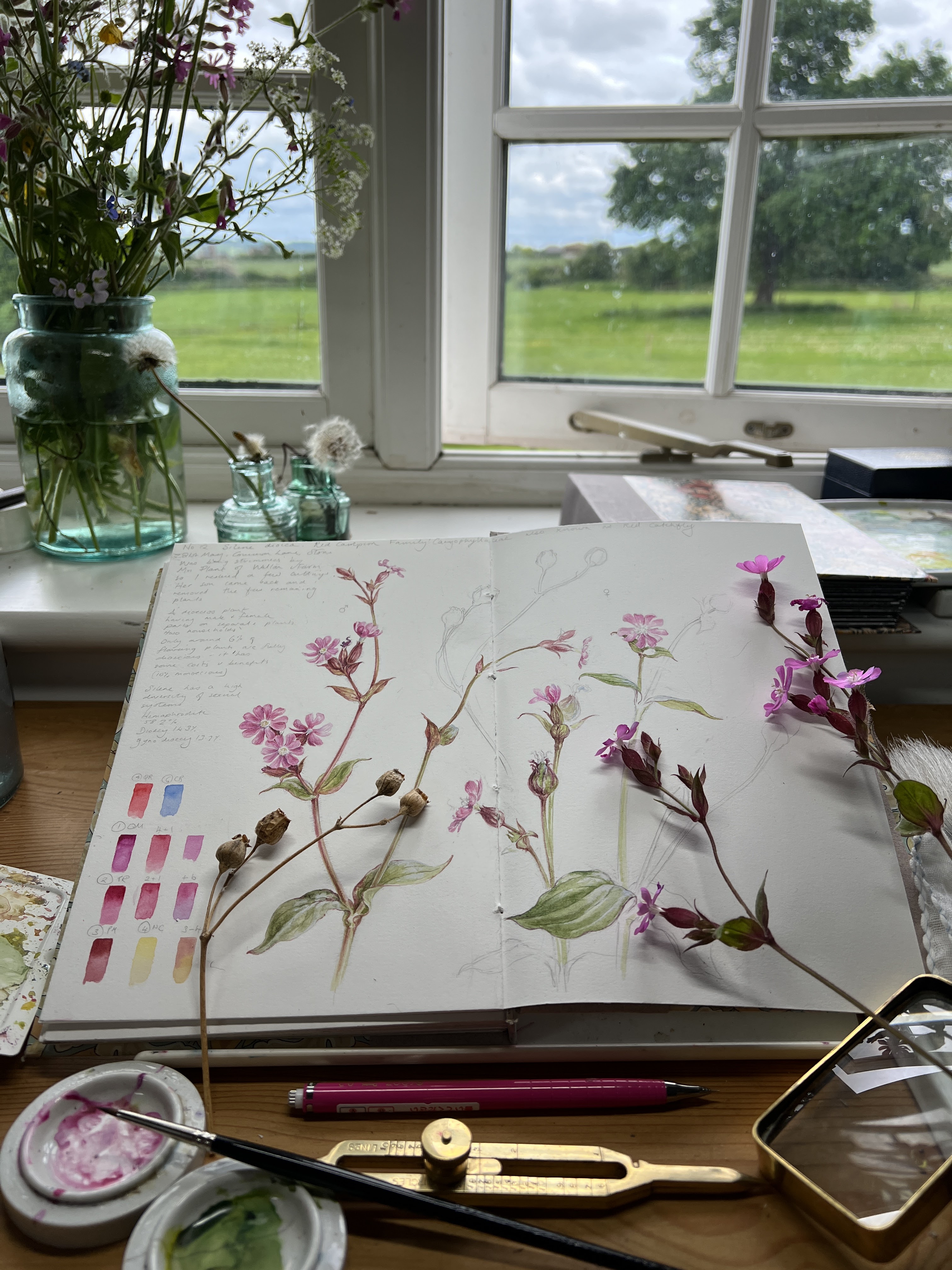
No 12, the last full page in the book before starting a new one is Silene dioica, Red Campion. It's one of my favourite flowers and as the name suggests it has separate male and female plants. There was an abundance of females but barely any males. I'd saved some seed podss from last year and added them to the page. When I went to finish the painting the lot had been strimmed, so I took some home and painted finished it off overlooking the field.  

Silene dioica, Common Lane, Stone. 21st May 2022


So that marks the end of the second sketchbook and will stop there apart from one more end piece, no. 13  Comfrey with a bee, bit of a rush job! 


Symphytum officinale, Common Lane Stone, 


For the next book I have more pages and its back to Saunders Waterford hight white paper. I'll  post the next batch soon. 

This project has been ongoing since February 2021 and I have been doing it with my good friend Debbie Crawford from the US. You can see all of our entries on Instagram under the hashtags botanicalsketchdates, which got hijacked by lots of folk, which it fine, so we started another with the hashtag botanicalsketchdates2022. 

Also on my own IG and Facebook page Dianne Sutherland Artist, where there's lots of other artwork too. 


Monday, 7 March 2022

Sketchbook: The Early Flowers (and their stories)

We're already into the third month of the year and spring will be upon us soon, so, it's time for a quick sketchbook update following on from my previous blog post. This year I don't have time to make a sketchbook page every week, but want to keep momentum with recording plants and fungi and aim to complete one at least entry every other week. The project has now come full circle and I'm seeing the plants painted last year back in bloom, this is definitely driving me forward with the project. Sticking to native and naturalised plants makes it slightly more challenging but there is really no shortage of plant material available at this time of year, here are some of the plants and one fungi illustrated between January and early March this year, but I begin with a look through the book in this short video clip. 

Below is a little about each entry because I can never fit enough information on the sketch pages. Each subject usually has at least one fascinating fact, including medicinal uses, pollination strategies, animal plant interactions, symbolism and folklore, food sources and much more.  


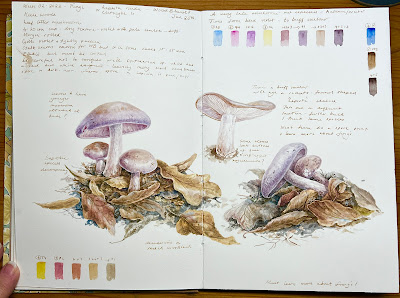
 January 25th, my second entry for the year was the Wood Blewitt, Lepista nuda

Found at Keele woods, which is on the site of the University where my daughter is a student.  I've made a few studies here before and there are some interesting plants and fungi which I hope to record in the future. The Wood Blewit is one of the latest mushrooms of the season which was unexpected in January,  the colour is a very attractive blue/ lilac and apparently they are a gourmet mushroom that appear through the leaf litter, this made a nice setting against the violet colour.  I'm  not overly confident in my identification skills of fungi and won't be eating these mushrooms any time soon as they are very similar to several poisonous species, such as the Cortinaruis fungi. Whilst scanning the surrounding area, as all nature artists do, I was also excited to spot a Medlar tree next to these mushrooms.  Note that I switched to using walnut ink here for the notes.....hence the top left splodge! 


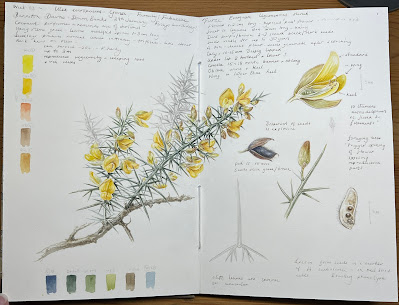
 January 29th,  the third entry of the year was Ulex europaeus, the common gorse (family: Fabaceae), also known as Furze 

These very common plants were found at Barlaston Downs, which is a national Trust woodland and heath, just a couple of miles from home. Gorse is a beautiful plant with a perfume of coconut, it always reminds me of my time living in Scotland and I can recall seeing the Yellowhammers flying in and out of the bushes, which surrounded my house. 
I always like to find out about medicinal or other uses for plants and Gorse is no exception, as an important plant in identifying the rare blood type known as the Bombay or HH or Oh Phenotype, first identified in Bombay in 1952. It turns out that Ulex europea contains Lectin in the seeds, which binds to 'H' substance in red blood cells. 
Most people will never know they have this blood type unless they are unlucky enough to need a blood transfusion. Individuals with this blood type are deficient in the H antigen, this is the antigen found on all red blood cells which is the precursor to the production of all other ABO antigens. As a result those with the Bombay phenotype may appear to be type O, however they carry an extra antibody which makes then them incompatible with the O blood type because they lack the precursor antigen known as 'H'. Thus they can only receive blood from other H deficient blood types, giving them a transfusion of another blood type will cause a very severe reaction. With only 0.0004% of the population having this blood type, it's pretty rare, so gorse has been instrumental in ensuring that those with the Bombay phenotype are identified and not given the wrong blood type. 


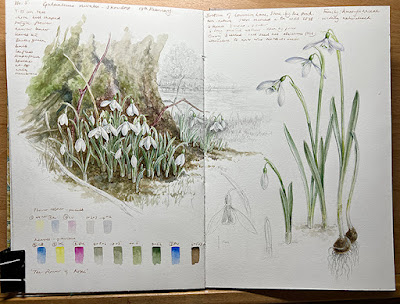
February 17th Galanthus nivalis, the common snowdrop (Family: Amaryllidaceae) 

These milk white snowdrops grow at the bottom of the lane where I live. It's not  a native plant but one that became naturalised and is thought to have arrived in Britain in the16th century. Although I try to complete pages in the equivalent of one day, this one took longer and I moved on the the next and returned to it over a week later. The idea of backgrounds is appealing but have to keep in mind that it's more time consuming.

The snowdrop is known as the plant of hope, simply because they signal the first signs of new growth in advance of spring but it also offers other hope to Alzheimer sufferers. This plant that has important medicinal uses, snowdrops contain the alkaloid galantamine, which is approved for use in the management of Alzheimers disease in over 70 countries, including the UK. The anecdotal use of the snowdrop in medicine has long been recorded and Greeks first acknowledged the effects of galantamine in Homer's Odyssey, when Odysseus used the snowdrop to clear his mind of bewitchment. In modern medicine galantamine was reportedly first extracted in the 1950 after a curious Bulgarian pharmacist witnessed the use of snowdrop leaves and bulbs being rubbed on the forehead of villagers, it was noted to be a chemical of importance in cerebral function. Galantamine was approved as a drug in Bulgaria in 1958 and in the US in 2001, it acts as a treatment for memory improvement for those with Alzheimers and mild dementia. 


February 20th, the fifth page of the year is Eranthus hyemalis or Winter Aconite (Family: Ranunculaceae)

These little plants were blown clean out of the ground during storm Dudley, which followed two other nasty UK storms. It was an opportunistic find when I saw them lying on the ground and gathered them up, they made a nice interval to painting the snowdrops. Winter aconite is another naturalised species first recorded growing wild in Britain in the 1830's although introduced in the 1590's. 
 It's a poisonous plant if consumed, although not as poisonous as Aconitum which it was at one time erroniously classified alongside because of its leaf shape, it is however in the same family, and all Ranunculaceae are poisonous to some degree. It contains some useful medicinal properties with the chemical khellin, this is a toxic chemical that acts as a vasodilator but can be converted into a harmless sodium chromoglicate used as a prophylaxis for the treatment of asthma attacks. Also amiodarone which is used for atrial fibrillation and arrhythmia treatment.

A Final Thought: Why are so many early flowers white or yellow?

you may have noticed thet many of the available UK native flowers at this time of year are white or yellow and quite small, which makes them challenging to paint, the inclusion of backgrounds or habitat can be useful when painting such colours because it makes them stand out. This approach is not completely unrelated to the existence of these pale coloured flowers in nature.  
In fact one of the reasons commonly cited in the prevalence of white and yellow flowers is related to the generalist pollinators, which tend to be small flies early in the year, these flies have an innate preference for white and yellow and with their dichromatic vision it's easier for them to spot the flowers against the dark background of foliage or the soil beneath them, so pollinator preference is believed to have driven the evolution of early white and yellow flowers. 
There are of course many other reasons why pollinators prefer certain plants and it's a pretty huge subject to delve into, so I won't go any further with it for now but will no doubt touch on pollinators and flower preferences in the future. 

My next sketchbook subject is also a yellow flower and another from the Ranunculaceae family, it's Lesser Celandine, Ficaria verna, which is just coming into flower. This plant is known as pilewort, for medicinal reasons which you can no doubt guess! 


This sketchbook project is a continuation of the botanicalsketchdates project which began in February 2021 with my friend from the US, Debbie Crawford.


Sunday, 16 January 2022

A New Year of Painting and Plants

Another year has passed and I've just completed the first of the 2022 sketchbook pages. This is a continuation of the same project as last year, 'Botanical Sketch Dates', which I've been doing with friend Debbie Crawford. My last post was up to week 38 of the book, there have been a few more entries since that time, so here they are. 

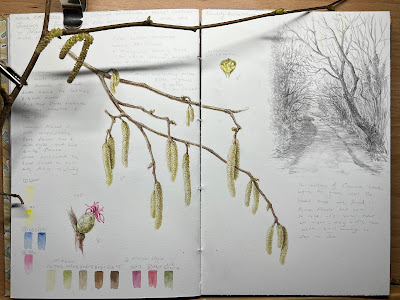
First entry January 2022 Corylus avellana, Common Hazel

The first for 2022 is Corylus avellana, Hazel. The catkins were out by the first week of January so seemed the obvious choice. It's a monoecious native tree which means it has separate male and female flowers on the same plant, being self incompatible it needs pollen from a nearby tree for pollination and to bear fruit. Cross-pollination is the preferred strategy for most plants because it increases genetic diversity but many plants can self- pollinate if all else fails, Hazel isn't one of those plants. 

The hazel nuts should be ready by July this year and I look forward to adding them. You can see that a  rough sketch of the Lane where the trees are located is included, this is something I may start doing on a more regular basis and first tried it in the Yew tree entry below, which included the medieval crosses at St. Mary's Church, Checkley. By the way, if you click on the images in the post I think you open a clearer image than the ones embedded in the blog post. 

Week 40 December 1st 2021, Taxus baccata, English Yew at the Churchyard, Checkley, Staffs. Featuring three medieval crosses at the site. 

With moving to a new year I did consider switching focus to garden plants, but in the end decided to stick with native, naturalised and some commonly found plants here in the UK. At the start of the project I had a broader scope but as the project developed, decided that native plants are my focus, they always have been really, and that's why I started painting plants all those years ago. With nearly 1400 native British plants and 1100 naturalised there are plenty to keep me busy. 

My interest is in learning about plants and habitats, so I'm sticking with the natives and hope to travel to a few new locations to paint this year, coastal plants would make a good addition and I'm definitely going to pursue some of the many dandelion species, this was something I learned about last year - did you know  there are over 240 species of dandelion! This doesn't mean I won't document the plants in the garden at a later date, they're certainly more colourful and easy access but I've hardly scratched the surface of our beautiful plant life to date! 

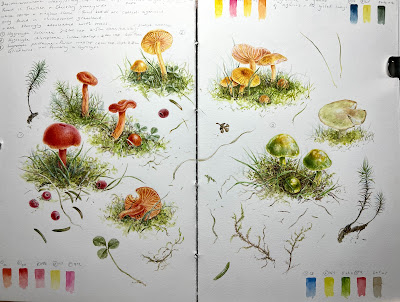
If you read my  previous post about sketchbooks and study pages, which included a video walk through of the book, you will know I also included fungi, this continued in November when I came across the wax caps at a local cemetery next to the Trentham Estate. The warm weather made it a good year for fungi, these little mushrooms are absolutely beautiful and very important too. The Parrot wax caps were found at Checkley graveyard the same week. I made a fun composition of them all together with some of the surrounding mosses and yew fruits, they seem to have an association with moss and I like to paint the substrate beneath - using a negative painting approach. Waxcaps are found in unimproved grasslands, but sadly I haven't seen them in too many other places, which says something about the state of our grasslands. The UK has lost 97% of its traditional meadow and grassland habitat and last year Plantlife ran a campaign with an app for people to look out for these beautiful little mushrooms, waxcaps are part of the species rich grasslands that are so important in carbon storage. Hopefully if Plantlife can find out about patches of remaining species rich grassland they can protect these areas.  

Week 39 November 14th - 21st 2021 Waxcaps: Hygrocybe coccinea (scarlet wax cap), H. chlorophana (golden wax cap) and Gliophorus psittacinus 

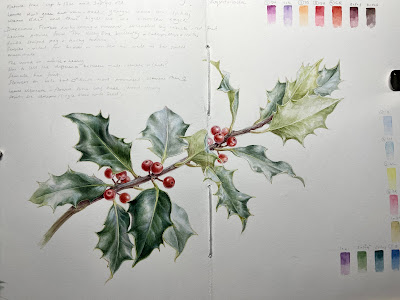
Christmas week I painted that old favourite, Holly, Ilex aquifolium, which is of our very few native woody evergreen angiosperms. Holly is dioecious, which means it has separate male and female plants, so you will only find fruit on female trees. It has such a beautiful glossy dark leaves and they take a while to paint because colour should be built slowly, I made use of aerial perspective to make the task easier and to increase the depth of the whole branch. The spikes are tricky to paint as they point forwards and backwards, so good lighting is our best friend when painting holly! That said the spikiness varies, young leaves and those low down have more spikes, no doubt to protect from browsing, the top of the plant has more smooth edged leaves. 

Week 41 December 23rd to 27th, 2021 Holly, Ilex aquifolium 

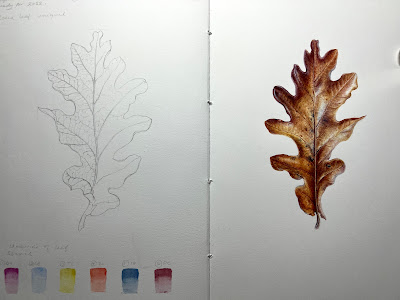
My final entry for 2021, was a simple dead oak leaf.  I look out on the oak trees from my window everyday as I paint, so it seemed a fitting end to the year. It also prompted me to start a small book of leaf paintings in a concertina sketchbook ....yes another sketchbook project! 

Week 42 on 31st December 202, a dried oak leaf, ready for the new year of plants and painting

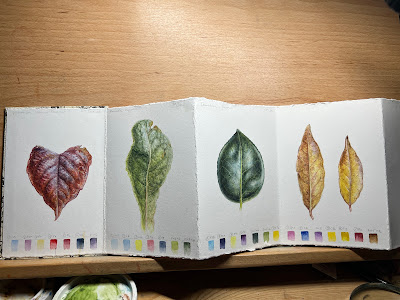
Finally, here are the first few entries in the little sketchbook of leaves. I promised a post about leaves a while back -  haven't forgotten but still working on it....it's a big old topic. 

A sketchbook of leaves for 2022

So that's all, I painted 51 species in 2021 over a 42 week period, it was great fun and I learned a lot about plants and painting. 

Looking forward to completing some actual paintings this year too and developing the website with more new tutorials to share.  Also thinking of doing a short presentation on some of the sketchpages so will keep you posted here.

Wishing you all a happy new year filled with plants and painting! 


Friday, 19 November 2021

The Value of a Sketchbook: Botanical and Nature Journal Insights

In late January 2021 fellow artist and friend from the US, Debbie Crawford, invited me to join her in a weekly botanical sketchbook project. The idea of a weekly painting seemed ambitious initially but here we are at week 39 and still going strong... we may be almost 3,500 miles apart but we keep in contact every week, most days in fact - to discuss our subjects, life, art and how we are getting along, this is a zero pressure activity yet it challenges us in a good way. The project and friendship became much more important as time passed through various pandemic lockdowns, we called it #botanicalsketchdates. It's filled the year with colour and learning and given me so many new insights into my own working practices with time to appreciate the seasonal nature of my surroundings with a good friend.

Arbutus undo watercolour painting
Figure 1. Week 38 The most recent entry Arbutus unedo, the Strawberry Tree. Not a native in England, but is found in southwest Ireland and the Mediterranean. An introduced species here it grows in my garden and is doing very well, most importantly it's beautiful and interesting.  No strict rules exist about what can and can't be included in the sketchbook. Too many rules can make the process restrictive and it can stall. As a result not entries are not native plants, others and are not botanical, fungi are included as part of the wider nature for their interaction with plants. Most entries are made from my wanderings of the local area where I live, others are further afield. 
  
The Art of Deconstruction 
Keeping sketchbooks is something that's preoccupied me for several years and reflecting upon my wider sketch page history, I hadn't realised quite how important sketchbooks are in my practice. Being science trained definitely made me more curious about plants with a desire to understand how things work but I've always had an element of curiosity, it was just less organised.... as a child I used to dismantle (i.e. break) toys, in particular dolls - to see how they fit together, a sketchbook is just my way of dismantling plants, making sense and understanding the features in relation to other factors such as environment, documenting, then working out how to put it back together together on a page etc. 

This deconstruction approach isn't for everybody, some people are more spontaneous, which is great, sometimes I am too and paint out of sheer desire to do so, there's no rule that a sketch page must be made for every painting - but the part I love most about plants is learning about them, and, if I'm going to make a finished painting it needs to be well informed - I guess it's a mechanism to remove the element of uncertainty and to get to know the subject up close - just as the portrait painter does. This is why study pages and sketchbooks feature so heavily in my teaching, it's a process of learning about the plant, its habit, environment and then how to approach it in a painting, it certainly makes it more interesting. I've recently been putting together my sketchbooks, study pages and finished paintings to show how I use them as  research in my process. Of course most of these sketchbook entries never make it to a final painting, but all are important reference and some do. 


Figure 2. Above: Calotropis gigantea, Giant Milkweed, sketchbook and finished painting (2018). I made these sketches in Indonesia, under difficult sticky hot conditions but it was essential to gather as much materials as possible because the painting was to be finished at home. I've been posting these 'Sketchbook to Painting' posts on my Dianne Sutherland Artist Facebook page if you would like to see more. I believe that I've understood a plant well enough when I can make a rough diagram from memory showing the following: floral morphology, basic reproductive strategy and parts, the leaf shape, venation and arrangement on the stem - only then do I feel like I'm in a good position to paint the plant. I decided this was a good approach after reading that it was a requirement that was employed in an examination by Ernest E Clarke, to draw a plant from memory! Clarke wrote the Handbook of Plant Form in the early 1900's. 

Always Something New to Learn 
The excitement of learning something new about a plant - one that I never studied or painted before is unrivalled for me, last week for example, when adding Arbutus undo to the sketchbook (figure 1), I cut open the bell shaped flower to find the these devilish little red anthers inside, then to make the connection - it's a member of the Ericaceae family, it has poricidal anthers with 'awns' which feature in other species this plant family. If you don't know what poricidal anthers are, they have a pouch type structure with a pore where the pollen comes out, pollen is only readily available available to pollinators that are capable of vibrating the anthers to release that pollen....  that's a whole subject in itself so I'll move on. They were worthy of getting the microscope out to investigate further and I was compelled to feature them in the sketchbook. I learned something new about a plant that pass everyday, that information is now fixed to memory. 


Figure 3. Arbutus unedo poricidal stamen, the strange appendages or 'awns' the whole thing looks devil or ant like. You can see the pollen grains scattered beneath as they spilled out of the pores at the top of the anther. These parts are are pretty small, a long arm binocular microscope was used - it's actually for inspecting circuit boards rather than using a traditional dissection microscope. It's low magnification and I fit a camera in the other lens socket. To be honest I don't use it all that much but its handy when I want to photograph and can't quite see enough with a hand lens.  

Figure 4. The reproductive parts inside the flower, once measured and drawn a better understanding is achieved

Figure 5. Adding the anthers and dissections to the page

Recording and Legacy 
The other side of sketchbooks is the importance in documenting or recording plants from an environmental perspective. For the botanicalsketchdates project I've documented many native plants in my locality, in the future such sketchbooks could provide important insights on species distribution, flowering time and habitats and plant communities, especially when accompanied by notes and location, comments about weather and of course dates. I always encourage my students to keep a sketchbook.  For me it's not all about making perfect finished paintings but about process, recording and understanding - although I also learn a lot about composition and painting painting of a weekly subject. I often go back to an entry adding mature fruits or additional comments about something that Iv'e noticed, it's important to note the date next to any additions, it will be interesting to observe the same plants over the years. I try to be mindful about what I'd want to know if I was looking at such a book in the future. 

Figure 6. Making later additions, in August fruit is added to the earlier honeysuckle entry, made in early July 

Figure 7. Lonicera periclymenum, from Down Banks, Barlaston, Staffordshire 

I leave space if there's something that I want to add later - even though it can leave an uncomfortable space on the page, I know its going to be filled later, the space has a purpose. 

Figure 8. Virburnum opulus Guelder Rose. A large white space is left top right but with the intention to return and add flowers next year. 


More About #botanicalsketchdates
This part was written several weeks ago but never finished or published - it's got some practical information on making a sketchbook and tells the botanicalsketchdates story up to week 34. Theres a little video walk through of the book and some fitting music for the passing seasons from Gavin Sutherland and Irmi Wolvin. 


       Video walk through up to week 34, with music from Gavin Sutherland and Irmi Wolvin

Prior to the pandemic travel had figured heavily for me.... probably too much and to be honest I was feeling tired, then out of the blue I was home...for a long time, this was the opportunity to explore my surroundings, taking walks, learning and recording the plants near to home - by March no one here in the UK could venture very far under lockdown - this project turned out to be the perfect antidote to isolation. Later on I was able to venture a further afield to paint and even made a return journey to Scotland. Before the pandemic I'd not spent a full Autumn at home for several years, so have really enjoyed this time of year again. 

Making a Sketchbook 
To begin, I set about making my own sketchbook, watched a few YouTube videos on different methods, gathered all the materials, a basic bookmaking kit from Amazon was under £10, and set to work. There are a few important points to bear in mind and the two excellent resources from Sea Lemon and Will J Bailey, are a great way to start, much thanks go to the people who take the time to share information in this way. My heuristic approach seemed to work out ok and the sketchbook, although far from perfect, was very usable with the best quality paper for watercolour. I also use Stillman & Birn books but felt that I wanted to use my usual watercolour paper for this project. 

I only had one block of Saunders Waterford HP High White that was the correct size (9 x 12 inches) and couldn't be bothered cutting paper because of all the issues with paper grain direction etc. and likely error on my part making mistakes when cutting. So I decided to work with what was at hand rather than buying more stuff, I figured that more stuff doesn't make anything better but this limited the number of pages, so I ended up with two volumes. I used the cardboard from the back of the watercolour block to make the hard cover, glued fabric to it from an old pillow case and covered it with some William Morris wrapping paper! to be honest it wasn't terribly well made but it worked and subsequent books are much better in construction, but it served a purpose.  SW paper isn't always the easiest for fine detail but I like it and it's tough stuff and good quality - the beauty of this is that you can choose your own paper.  For the second volume I switched to Stonehenge Aqua, my other favourite paper, which I find facilitates better fine detail (in my opinion). 

Figure 9. This is my most recent book with 52 double page spreads. I used the 4 needle Japanese stitch (you can find this on Sea Lemon's You Tube), it sits pretty flat,  a hardback cover was added and the spine was glued with linen, so represents a step up for me from my first book which has some big gaps between some pages, I don't mind the gaps but I do like to work across the centrefold so wanted to remove and any gaps this time - it's still far from perfect but I'm learning. It takes about a half day to make this book but if gluing the spine it will need to be left overnight to dry under heavy books. 


Figure 10. Finished book ready for 2022


Choosing Subjects 
Some times I'm not so happy with my choice but always stick with it - other times I am, that's just the nature of painting plants. However,  I always enjoy the process of choosing the subject, some subjects fill me with enthusiasm, other seem inviting but then don't turn out as I thought and then there are those that I never expected to paint but stumbled across and really enjoyed, this can actually change our direction in interests and facilitate a whole new area of work. My choices are not planned much in advance and are often opportunistic finds. One such subject was a fungi, which isn't even botanical but whilst out walking I came across this fly agaric in the strangest way - setting off for a daily walk and for no reason at all, I was thinking that I hadn't seen fly agaric for years, maybe 15 years or more. For some reason wandered left into the trees, which I seldom do and there it was! under nearly every birch tree, so it had to be included and fungi has such an association with plants and the environment that I felt it deserved a place. Such was the excitement that I've since added Ink caps and my week 39 is wax caps. It seems to be a bumper year for fungi here  - that goes back to the possible historic importance of recording what we observe in nature.  

Figure 11. A chance finding Amanita muscari

Figure 12. An absolute pleasure to paint, Fly Agaric. If it appears next year its going on vellum 


The Rule of no Rules 
Sometimes I'm asked about 'rules' for creating sketch pages, there are no rules that I'm aware of, I just begin by putting down the main focal point, i.e. the part of the plant or subject that anchors the illustration to the page. I don't really give it much thought, it's intuitive and I let the plant lead the way in an organic way, for example, a long curved flowing stem, such as honeysuckle (Figure 7.) is asking to crawl across two pages, with the flowers in a key position making the focal point for the viewer. It's kind of common sense, like where you put furniture in a house, then just add the bits around it, most important is to observe and learn about every plant, return later for the fruits and leave a gap for them. You can't analyse it because every plant or entry is different but there are some common features. Sometimes I do the whole dissection/deconstruction and other times I don't, it depends on the direction that the plant leads me into. 

Every Subject is Different 
I have a number of approaches but it's dictated by the plant. Sometimes using a combination of watercolour and graphite to create depth and separation enables me to create a jumbled growth habit, shown in the bramble, figure 15. This also speeds up the process of completing something that would otherwise take too long - I try not to spend more than one day on each entry, I grab a bit of time when I can often first thing in the morning but also spend time looking at the subject and reading about it or asking myself questions and have to make decisions dependent on available time for each plant, some can be completed quite quickly whereas others are more complex.

 For small graveyard plants in figure 12,  I painted three little habitat clumps as micro habitats over three weeks. The dandelion I made studies in figure 14  of but felt I had to paint it from above because that's the way I generally encounter it, seen in figure 13. All are different.

Figure 12. Three little habitat clumps Viola, Oxalis and Daisy from the graveyard

Figure 13. I made two Dandelion entries for this the first was a deconstruction (below), the second was the usual habitat view 

Figure 14. The Taraxacum officinale deconstruction 

Figure 15. Using graphite to create more complexity a Bramble another two page spread  

Figure 16. A mixed composition of wildflowers made in Scotland. I think this was may favourite to do - probably because of my associations with Scotland, and the lovely road trip exploring, which was a treat after being home for so long. Its a memory page!

To Conclude: Anyone can keep a sketchbook! 
The main take home point with a sketchbook is to never be afraid of a blank sheet of paper - fear only prevents things from happening, just enjoy the process and learn about nature. After each entry I wipe the decks clean and forget last week and start making the mess again. Some entries are painted outdoors, at least in part, and others are painted at my desk looking over the fields from my window, the strawberry tree, dandelions, harthown, hips and many others conveniently grow in or next to the garden. I grab an hour early in the morning or late at night if I'm short of time. Of course it depends what's available with plant material and how much time you have but anyone can keep a sketchbook and there's always something to draw or paint... the plants will lead the way.

Early morning painting