Showing posts with label sketches. Show all posts

Saturday, 27 December 2014

The Sketchbook Project, nearly one year in!

It's been a bit of an unsettled year, although that seems to be the norm these days!  haven't painted as much as I would have liked but there has been one project that really stands out, the Nature Sketchbook  Exchange Project.
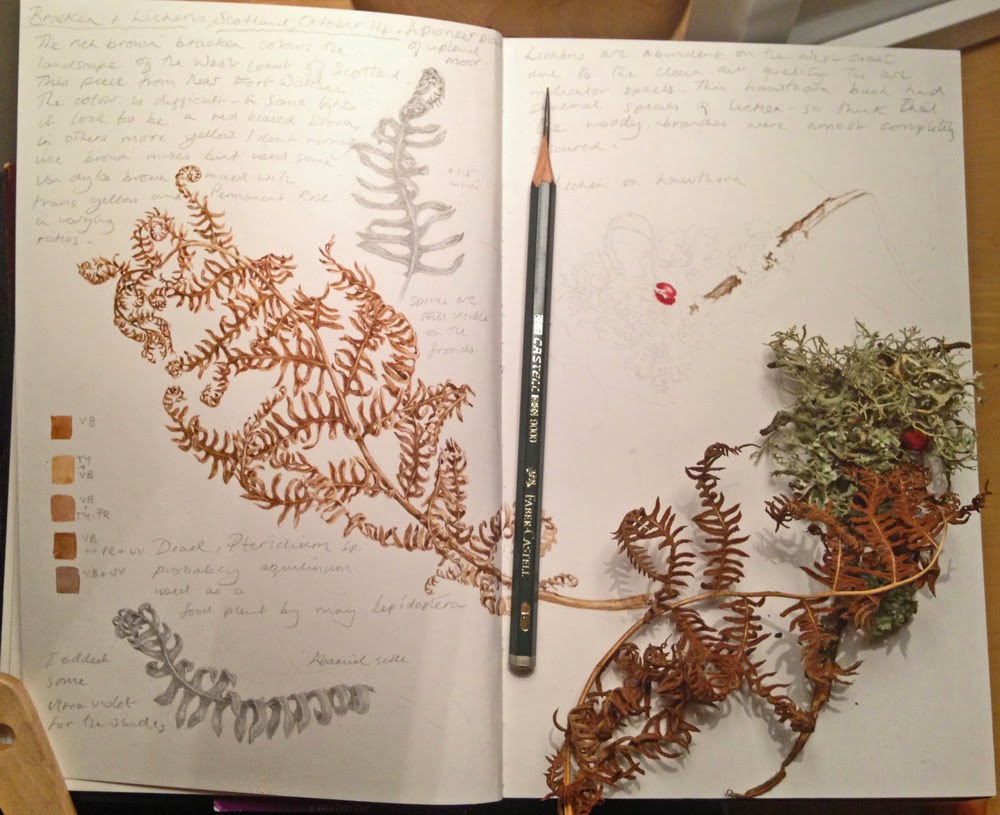
Latest entry, sketchbook no. 8, work in progress in Doreen's book. Bracken and Lichens ( on hawthorn) from the W. Coast of Scotland, near Fort William. The decomposing bracken is very dominant in the landscape and I love that rich brown colour. The abundance of the lichens on the trees alters the colour of the trees, in places it's so thick you can barely see the branches at all. Lichens are indicator species for air quality, so it's obviously pretty clean in that part of the country. Hopefully I'll find a few hours to complete these pages before the year end.
It's fairly self explanatory as a project but for those of you who don't already know about it,  the Nature Sketchbook Exchange is basically a group of 16 botanical artists exchanging, and working in, each others sketchbooks,  we work on any nature based subjects of our choice - so by the end of the project we have work by every other artist in our own book. I'm currently on my 8th book ( including my own) so about halfway through and about a year into it come January! This fantastic project was initiated by my good friend Shevaun Doherty,  who also has one of the best botanical/ nature art blogs out there!
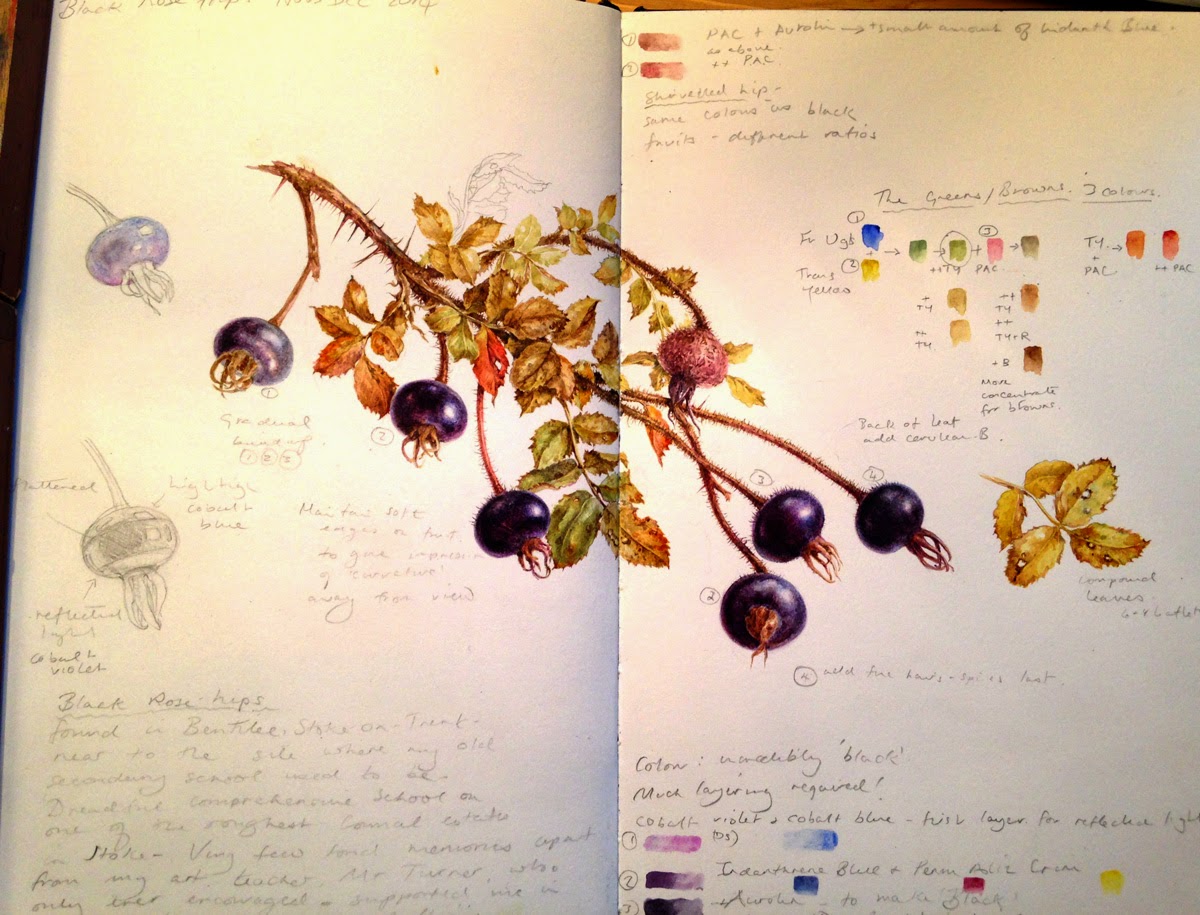
 
No. 7 Sketchbook. Black Rose hips for Frances' book, I found these in Bentilee,Staffs, near my old school. My first bit of work in my new flat (Nov, Dec). I spotted these hips on a routine drive to my daughter's house and pulled off the road to collect some, there were hundreds on the bush, so I didn't feel too bad about taking a few.
 After a year I feel as though I'm settling into the project and not quite so nervous about working in another artists book.  What's been really great is the luxury of getting up close to other artists work, which gives an insight into their working practice. Each artists identity emerges through their entries and everybody brings something different to the project.
Also being able to paint whatever I fancy painting with plenty of time is a luxery, there's never a problem finding something for a quick study and I always keep my eyes open, constantly scanning for the next subject! .....It might just be something I spot while on the way to the shops,  I often stop the car and collect a few fruits or find some interesting leaf or branch lying on the ground!  I add as little or as much as I want to each entry and some pages are more finished looking than others.
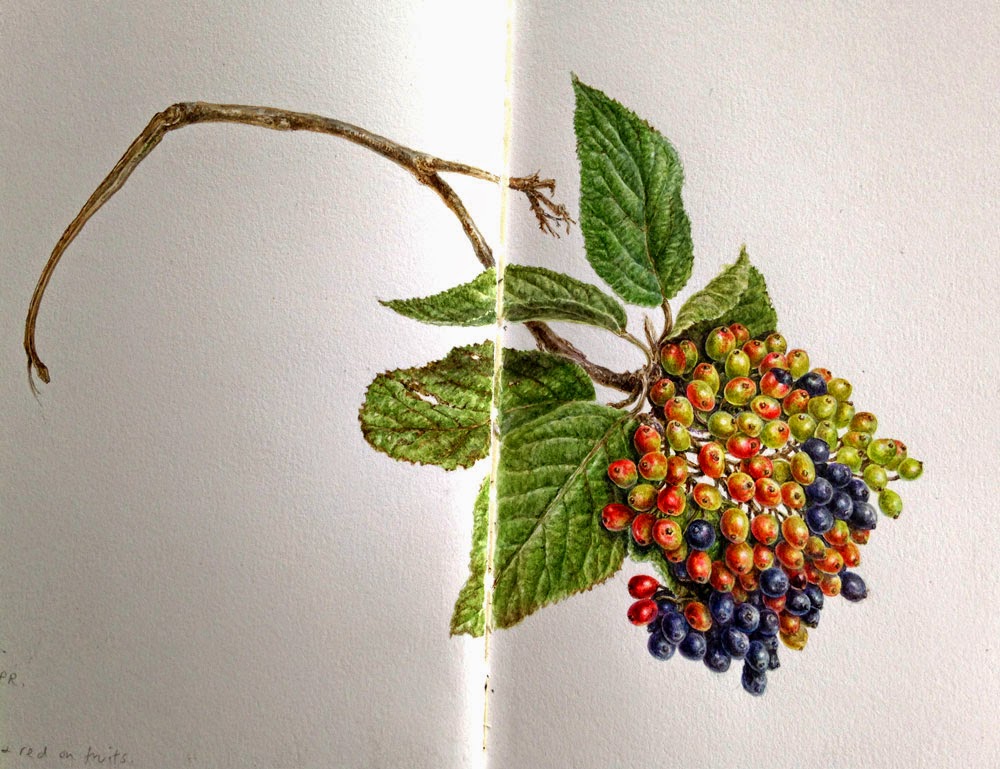
No. 6. Not many notes here because there wasn't much to say. This is a fruit branch from the Wayfarer Tree, collected from a car park in Germany for Claire's book. I just fancied painting with no preparation, in trial and error fashion. Painted at my daughter's house, I borrowed her dining table while she was out because I was in between moving at the time ( Sept - Oct)

In the past I  never used to keep a sketchbook and kept rough work in boxes and on bits of paper but in recent years I've been re-educated into seeing the benefits of keeping a good sketchbook.
In addition to the project, I now keep several other sketchbooks which act as a plant library or painting and drawing diary. It enables me to paint things that I might otherwise forget about or just not bother with, usually because of a lack of time. Sketchbook work doesn't require a huge investment in time, so I often paint flowers and seeds from my travels or just document plants thought the year along with personal notes, it doesn't matter whether they are finished or not. It's proving an invaluable resource and making notes helps with the botany too.  Sketchbooks remind me of where I was and what I was doing at a particular time....I remember where the plant was and who I was with....... and all the little things that were going on around each entry at that point in time.
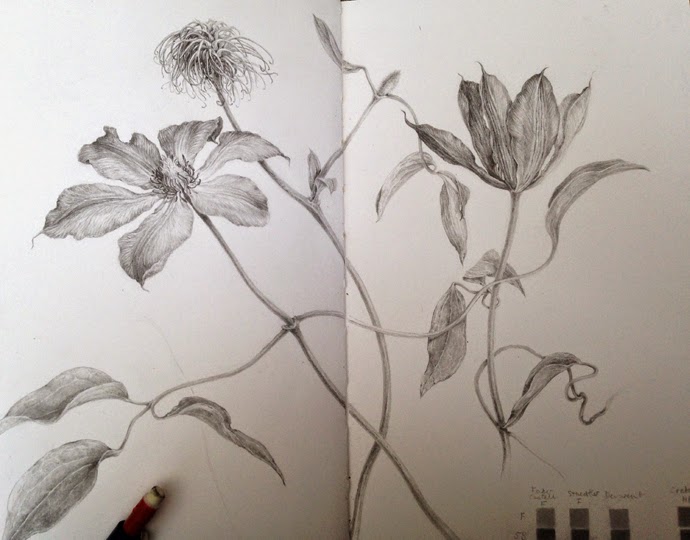
No. 5 A change of medium, Graphite Clematis from mums garden for Sarah's book. Drawn at mum and dad's house (July, August)

All of the artists working on the project use the same type of book, the Stillman & Birn Zeta series, hardbound, 8.5 x 5.5 cm, smooth,  270gsm,. Previously I thought that there was no decent sketchbook paper, but this is a really great book! I've purchased several now, in different sizes. Initially it felt a bit different because I pretty much always work on Fabriano Artistico for everything but I got used to it very quickly and love it!
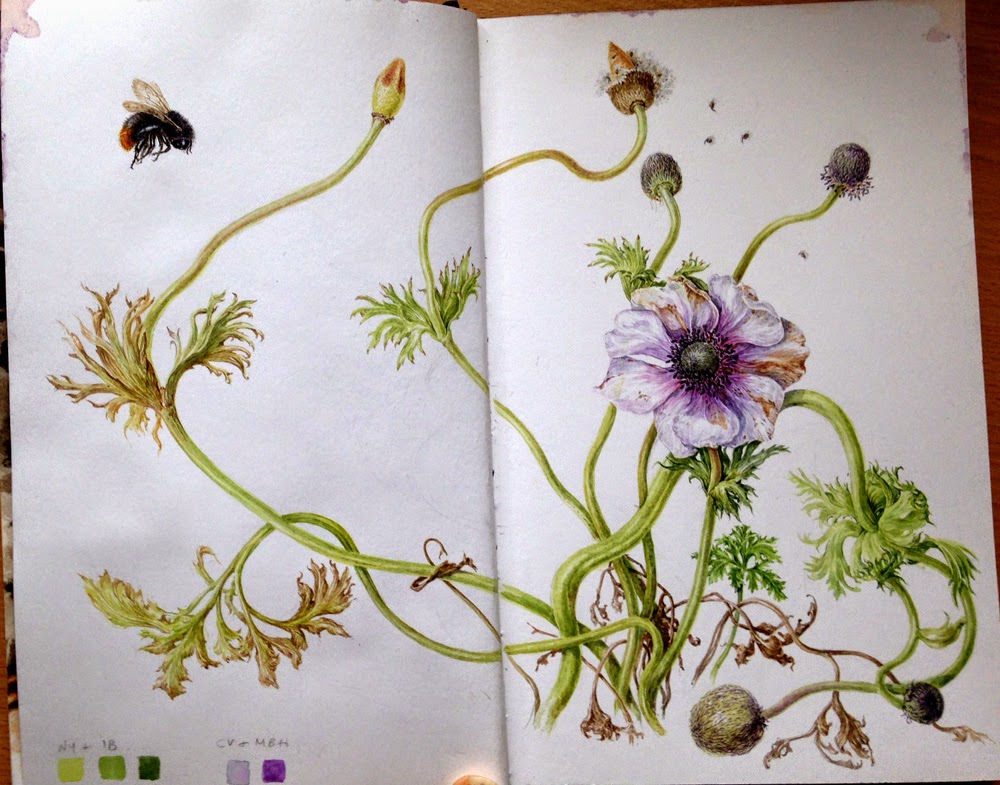
No. 4 Dying anemone and a dead bee resurrected! For Jarnie's book. This sprawling plant had seen better days, I found the bee dead Queen bee in the porch. Painted in my previous house shortly before I moved ( May, June) 
I have started to notice a pattern with my layouts, most of my compositions sprawl across the pages but the entries are changing and I feel more relaxed about no trying to produce finished pieces in the more recent books, they are much more like my usual study pages.
 
No. 3 Fox Grapes and grape hyacinth for Terri's book. I grew these plants in pots from the bulbs painted in my own sketchbook cover pages at the start of the project (see below). ( March, April).
 Hopefully, this time next year I'll be able to post the remaining images from the sketchbooks yet to be received. I'm currently waiting for Shevaun's book, no idea what to paint but might find inspiration in Ireland when I visit in January. 
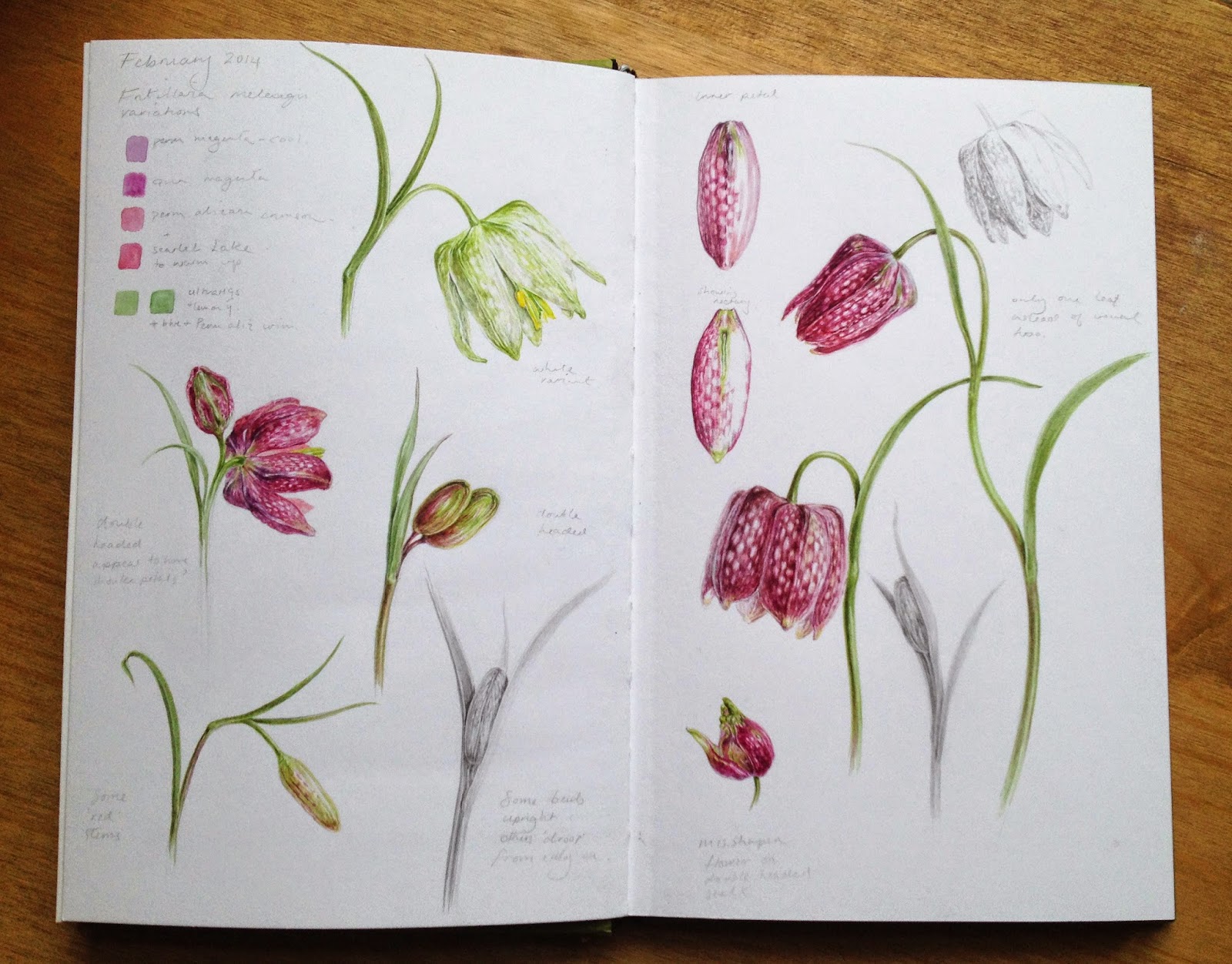
No.2 Fritillaria studies for Lorraine's book. My first attempt at painting in another artist's book.....bit scary at first but soon get used to it. It's only a sketchbook so mistakes are part and parcel! I  used these as part of the preparation for the RHS show paintings which were exhibited in London during April.
If you don't yet keep a sketchbook, I hope that you'll be encouraged to do so. It really is a good for pracice and reference but also a great escape....particularly when life is turbulent! 
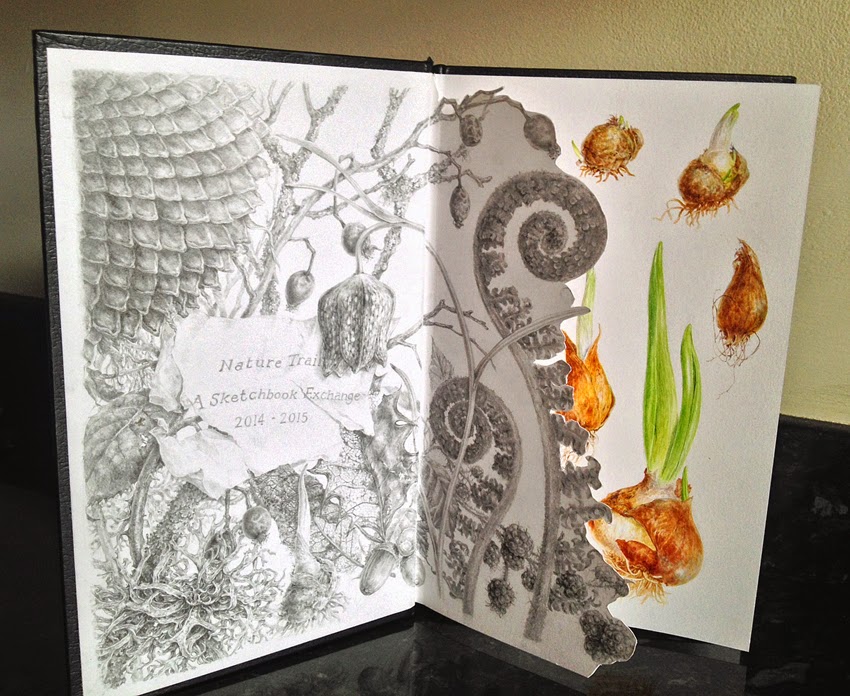
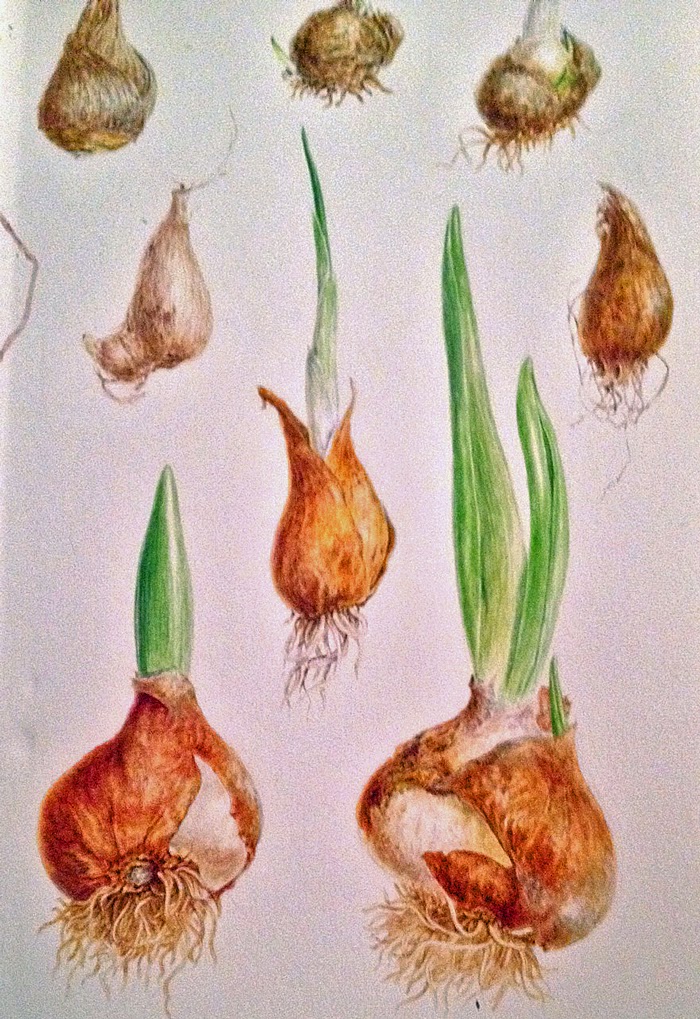
No. 1 Beginnings, my own sketchbook. Inside cover page in graphite is a drawing /doodle styled work from the corners of the grey matter! The first pages of bulbs seemed appropriate subject to start with. Great fun to do but a bit over the top with the graphite, also I forgot to spray it with fixative so doubt there won't be much left by the time it's travelled around.
Bulbs seemed suitable for the beginning!
This time next year the project will be coming to an end and can't wait to see all the beautiful works from each artist in my book.... It will be something that I'll always treasure!

Thursday, 21 August 2014

Summer Travels.....a Sketchbook Encounter with Linnaeus's 'Monster'

Last week I travelled by road to Austria and Switzerland via France, Belgium, Holland and Germany....it was a long way! But the opportunity to paint the flowers on this trip was too good to miss. It's a long time since I've painted wild flowers and I'd forgotten that it can present quite a challenge.... and when the weather is wet it's near on impossible at times! Nevertheless I managed to produce some sketchbook studies and notes and took lots and lots of photographs. There's a whole heap of material from my trip so will spit it into two blog posts. Next week I'll focus on the mixed study pages but first off I'm dedicating this post to common Toadflax. It's a pretty common plant but it's an old favourite of mine so I make no apologies for getting carried away with it.....sometimes the story behind a plant makes a plant too tempting!
Linaria vulgaris L. (Common Toad flax) study page. Commonly found on disturbed ground at the roadside in Austria, Germany and Switzerland ( and much of Europe). This one was found in Germany near the roadside on waste ground. Note the mutated plant on the right.
The reason I couldn't resist Linaria vulgaris was sentimental, having grown it in my garden in Scotland some years ago, I'd been given a young plant from Aberdeen University Botanic Garden where I worked in 2005. Although I'd written about and it had flourished in the garden, I'd never actually painted it - so it was nice to encounter it again in Germany, Austria and Switzerland, where it can be seen at almost every road verge at lower altitude. Initially and visually it wasn't a plant I was particularly interested in painting but the history of the plant really is fascinating and it became  more interesting as I studied it. I first learned about L.vulgaris when I chose to write and essay about floral mutations for an assignment about Carl Linnaeus, to celebrate the tercentenary of his birth - this task was part of a course I undertook with Uppsala University in 2007. The University provide some great resources on Linnaeus for anyone interested.
Carl Linnaeus had a particular interest in L. vulgaris because it is prone to a strange mutation which he first described over 250 years ago. A mutated form occurs on occasion, and the plant produces radially symmetrical  flowers with five spurs instead of the usual bilateral flowers, which have just one spur.
Left: The normal bilateral flowers with one spur. Right: the mutated 'Peloric' flower, exhibits radially symmetry with five spurs. The mutation is caused by a defect in the Lcyc (cyclooidea like gene) which controls the dorsoventral asymmetry in 'normal' flowers. Similar mutation is found in Antirhinums.
 Apparently Linnaeus was so captivated by the plant and the mutation that he grew it by his front door at his summer home in Hammarby for many years. He had originally been presented with the 5 spurred mutated version in 1742 by a young botanist, Magnus Zioberg and went on to write a thesis describing the mutated plant in 1744.
Carl Linnaeus, was the first to write about the peloric form of Linaria vulgaris over 250 years ago. Copyright Wikimedia Commons 
  Linnaeus placed the mutated plant in a separate classification from L. vulgaris and named it  'Peloria' which translated in Greek to 'Monster'. He could only conclude that the 'Monster' was an example of hybridisation which resulted from interbreeding between two separate species and suggested common toadflax and some other unknown species had interbred to create a new species. This controversial view challenged the religious views of the time and presented Linnaeus with a problem which left him in conflict with the church. The problem of conflict persisted for him as he developed his sexual system and classification of plants, which were seen to question God as the creator. Linnaeus's work was banned and ordered to be burned by by Pope Clement the XIII and he was accused of impiety by the Lutheran Archbishop of Uppsala.
L. vulgaris has continued to fascinate and has been discussed in works by numerous evolutionary biologists, including Darwin, de Vries and Huxley, and used as an example of how mutation can lead to changes in morphology.  Read more about Linnaeus's Peloria
The mutation is now known to be caused by a single gene mutation. Linnaeus was wrong because L. vugaris was not a separate species but the principle he identified was an important one in evolutionary biology and the L. vulgaris research continues to this day.   
 
The study page, Linaria vulgaris I worked on 14 x 10 inch Langton extra smooth HP paper ( kept in a plastic bag!)
I also had a small notebook for listing species and notes.
Although its only a study page I still prefer to create a well balanced page so try to fill the space as evenly as possible. This usually happens fairly naturally as a rule. Just make sure nothing is too cramped or far apart. 
  • I make one colour study of the whole plant in situ to document the general plant 'arcitecture'  - this is the focal point of the page. 
 
Focal point - whole plant, quick watercolour sketch in colour
  • After drawing the whole plant I make some small colour studies at the page edges before drawing and painting a couple of flowers to test the chosen colours. I had a fairly limited palette. An Ultraviolet light wash was used for the shadows. I put this in first because it's a light flower and I find it easier to lay shadows first on light flowers). I used Lemon Yellow (NT), Cad Lemon and Cad Yellow. For the greens I used Cerulean Blue, Cad Lemon with a small amount of Perm rose. I also added some Fr Ultramarine for the darker greens. I varied the ratio of  the colours for the lighter and darker shades ( i.e. more yellow for the lighter stems and new growth). I made a couple of smaller studies of the individual flowers in colour to test the colour before painting the larger piece. I think that I would change the Cad lemon for Win Yellow if i were to paint it again because WY is transparent. On this occasion I didn't have it with me.    
 
Colour studies
  •  A simple line drawing of the plant was also made for clarity - this enables me to get a really clear understanding of the plant in terms of the leaf and flower arrangement on the stem.
 
Line drawing, whole plant stem
  • Flowers are the feature of the work so I made studies of the regular bilateral flowers, front and side view ( required for a bilateral flower ) I already had a rear view in colour, so no need for duplication but I did also draw a flower which had yet to open. These were made in graphite using a 2H and HB pencil and scaled x 1.5 for clarity. I made a single study of the mutant flower ( only one study required because it's the same on all sides). Peloric version shown above in main text.  
Flower studies showing various stages and views
  •  I didn't draw the reproductive parts other than the stigma on spent flowers but could possibly track down a potted specimen at a later date if I wanted to add this.
  Back to the Travels
After many hours of travel and an overnight stop in Germany we finally arrived in Kappl, a small village in the Paznaun valley, Province of Tyrol, Austria. Kappl is located over 1,250 m above sea level, the clouds roll through the mountains and the air feels incredibly clean.   As we climbed the winding roads a far greater diversity of flowers was immediately apparent. Many of the plants commonly seen can be found here in the UK but seldom is there such diversity in one small area. In my next post I will share the mixed study pages from Kappl and St Moritz.

The road up to Kappl where a diverse range of Alpine flora was found.