|
| Black Acorn, found Longton Park, Sept 2013 |
Monday, 30 September 2013
No. 27, 30 Day Challenge, Black Acorn
I found this little black acorn in the local park. I don't know anything about it but it's a lovely little thing, so I thought I'd paint it before it withers away. It's tiny.... only about 1.5cm across! It has to be my favourite subject so far... so simple and quick to paint too!
Colours: First I laid down a wash of Manganese Blue Hue and Cobalt Violet, leaving the centre of the brightest highlight clear. I added a light wash of Indanthrene Blue and Permanent Carmine. A small amount of Aureolin was added to the same mix and added a couple more washes laid down to achieve the velvet black colour, the first wash was added while the previous layer was still damp so that the edges of the shine at the base and around the highlights remained smooth and soft. I added a little French Ultra Green Shade and Violet Dioxide to the right hand side for reflected light. Detail in the form of fine lines was added to the acorn using a size 1 brush using the black mix. A very small amount of Raw Umber was added at the base of the acorn. For the cap I used a mix of Raw Umber and Cobalt blue. The stalk I used raw Umber and Perylene Maroon and a very light wash of Manganese Blue Hue in selected places for the highlight.


Sunday, 29 September 2013
Day 26 of the 30 Day Challenge, Autumn Mahonia Leaf
I found this leaf a couple of days ago in the local park. It's some type of Mahonia and was still on the plant, which had just starting to change colour on odd leaves, this was the most advanced with just a small amount of green remaining at the base and leaf margin. It belongs to the same plant family as the two leaves I painted earlier in the challenge, they were old leaves, found in the leaf litter, so probably from last year. This one is much brighter. Doesn't seem possible that a plant can change from a dark green to such an intense red!
 Colours: A wash of Transparent Yellow was laid down first. While still wet I added a mix of Quinacridone Red and Permanent Carmine. I continued to work on the leaf while wet and added Perylene Maroon to the red mix to darken slightly. I layered the washes and painted around some of the most dominant veins. I also added a mix of Raw Umber and French Ultramarine for the light brown areas and Cerulean Blue on the Highlights. For the green I used a mix of French Ultra Green Shade and Transparent Yellow. While still damp I added some faint brush work to pick out the darker edges around the veins using Perylene Maroon and Burnt Umber - this approach gives softer edges and the suggestion of veins. Once dry I added some dry brush work wher the reds were richer and added some Neutral Tint to the red mix. A final wash of the initial red mix was applied in selected areas but adding some Aureolin to it this time, this served to brighten the reds in places. I continued to add detail around the veins, leaf margin and in the indentations where the leaf curves.

Saturday, 28 September 2013
No. 25, 30 Day Challenge, Portugal Laurel Berries
Not long to go now!! not sure how I'm going to finish this challenge because I'm travelling to Amsterdam on Tuesday....but I'm sure I'll find something on route and when I get there!
Today I chose the very pretty Portugal Laurel, Prunus lusitanica, such a lovely variation in colour in these berries so I couldn't resist! Started it this morning but had other things to do so finished tonight. These days I find natural light so much better to work in than artificial light....but no choice and the nights are drawing in fast now too, so it's back to the lamp!
Colours: For the red berries: Quinacridone Red and Permanent Carmine.
For the green/ yellow berries/ Red. First a wash of Green Gold, followed by a blended wash of Aureolin and Manganese Blue Hue mixed to make green and blended into a mix of Quinacridone Red.
Once the basic washes were down I started to add dry brush on the reds a mix of Permanent carmine and Indanthene Blue. In the areas where the red was warmer I used Perylene Maroon. To brighten areas I added a light wash of the Quin red and Aureolin.
Stem. The same green mix was used as for the berries. Permanet Carmine was added to the red stem areas and the small details. For the remaining old filaments and anthers I used Burnt Sienna and Sepia.
Today I chose the very pretty Portugal Laurel, Prunus lusitanica, such a lovely variation in colour in these berries so I couldn't resist! Started it this morning but had other things to do so finished tonight. These days I find natural light so much better to work in than artificial light....but no choice and the nights are drawing in fast now too, so it's back to the lamp!
 |
| Portugal Laurel, from Longton Park, Sept 2013 |
 |
| Detail |
For the green/ yellow berries/ Red. First a wash of Green Gold, followed by a blended wash of Aureolin and Manganese Blue Hue mixed to make green and blended into a mix of Quinacridone Red.
Once the basic washes were down I started to add dry brush on the reds a mix of Permanent carmine and Indanthene Blue. In the areas where the red was warmer I used Perylene Maroon. To brighten areas I added a light wash of the Quin red and Aureolin.
Stem. The same green mix was used as for the berries. Permanet Carmine was added to the red stem areas and the small details. For the remaining old filaments and anthers I used Burnt Sienna and Sepia.
Friday, 27 September 2013
No. 24, 30 day Challenge, Maple Leaf
Rushed attempt today, not happy with this.... but here it is! There are actually 2 leaves drawn on the page but it's been one of those days! A fairly short post blog post tonight too.
These leaves are a bit tricky because they have no shine at all, that makes for a bit of a flat painting. I suppose I suppose I could have wet the leaf to create a shine but I'm afraid I started started off with little thought today.

Colours: First wash, Naples Yellow all over. Pink colour wash applied selectively on top of the yellow, using Permanent Rose. Try not to form lines at either side of each vein because this results in 'tram lines' - unnatural looking relief veins.
Continue to build up the pink. Add darker detail, picking out veins, blemishes and leaf margin, using a mix of French Ultramrine and Burnt Sienna. A light wash of Aureolin was added to brighten the yellow. To get he dark leaf margin wet around the edge of the leaf and drop the colour on so that it blends rather than forming an outline. I would have normally continued with dry brush work at this point but had to leave it at this point.
Thursday, 26 September 2013
No. 23, 30 day Challenge, Conkers
A painting challenge at this time of year just wouldn't be complete without a conker! Love collecting conkers but I'm sure that they're smaller than they used to be when I was a child....or maybe it's because I'm bigger! Anyway here is my conker offering for the 30 day Challenge.....just one more week to go!


The Horse Chestnut leaf is one of my favourites to paint, they're amazing colours as they age! A slight aside but here are a couple of leaves painted over the last few of years.
Colours: Conker. Outer casing. A wash of Cinereous Blue ( Sennelier) and Transparent Yellow with a very small amount of Permanent Alizarin Crimson to take the edge of the bright green. Highlights were left clear. A small amount of Cerulean Blue on the highlights. Build up in layers adding a wash of Green Gold. For the dark markings I used various combinations of Burnt Sienna, Raw Umber and adding Indanthrene Blue for the darkest marks.
Conker, Burnt Sienna and Perylene Maroon applied in washes, leaving the highlights clear. Dry brush was used to build up the depth of colour and texture and a small amount of Neutral Tint was added for the darkest shades. I also used Cerulean Blue around the highlight and Cobalt Violet for reflected light. I used Ultraviolet for the shadows.
 |
| Conkers, Sept 2013 |


 |
| Horse Chestnut leaf on vellum 2011 |
 |
| Horse Chestnut leaf 2012 |
Conker, Burnt Sienna and Perylene Maroon applied in washes, leaving the highlights clear. Dry brush was used to build up the depth of colour and texture and a small amount of Neutral Tint was added for the darkest shades. I also used Cerulean Blue around the highlight and Cobalt Violet for reflected light. I used Ultraviolet for the shadows.
Wednesday, 25 September 2013
No. 22, Acorns with Wasp ' Knopper' Galls
I visited Longton park in the pouring rain this morning. Things have changed a good bit since I was last there several weeks ago and the leaves are now starting to turn golden and falling. Got a lovely haul of things to paint, most of which had fallen to the ground....probably enough subject material for another week of painting. First up are these Acorns with their curious wasp galls.


The Acorn Gall wasp, Andricus quercuscalicis, causes these strange Knopper Galls on Oak acorns. The wasp oviposits its eggs in the acorn in early Summer as the acorn starts to develop. The egg hatches into a grub which then secretes chemicals causing a gall to form. The grub pupates inside the gall and emerges in the following year.
The wasp has a two generations per year and requires both native Pedunculate( English Oak) Quercus robur or sometimes in Sessile oak, Q.petraea, and, Turkey Oak Q. cerris . The first generation of adult wasps to emerge in spring are all female, they lay their eggs in the young oak buds. The second generation of the life cycle sees sexually reproducing male and female wasps emerge from the galls, the female returns to lay eggs on the English Oak and the cycle begins again. The Acorn Gall wasp has only been known to be in Britain since the 1950's, having made its way north from Europe. The introduction of the Turkey Oak to Britain in the 1700's eventually facilitated the arrival of the wasp from Europe.
Colours: Lower acorn, Gold Ochre and Burnt Sienna, built up in washes with a wash of Transparent Yellow applied on top. Highlights were left clear and a small amount of Cerulean Blue used to bring the highlight forward. A little dry brush work was used the build up the rich colour on the acorn. Acorn 'cap', Green gold, Indanthrene Blue and some Burnt Sienna on top for the indents.
Gall, Burnt Sienna and Raw Umber with Ultraviolet and Indanth Blue for the shadows.

The Acorn Gall wasp, Andricus quercuscalicis, causes these strange Knopper Galls on Oak acorns. The wasp oviposits its eggs in the acorn in early Summer as the acorn starts to develop. The egg hatches into a grub which then secretes chemicals causing a gall to form. The grub pupates inside the gall and emerges in the following year.
The wasp has a two generations per year and requires both native Pedunculate( English Oak) Quercus robur or sometimes in Sessile oak, Q.petraea, and, Turkey Oak Q. cerris . The first generation of adult wasps to emerge in spring are all female, they lay their eggs in the young oak buds. The second generation of the life cycle sees sexually reproducing male and female wasps emerge from the galls, the female returns to lay eggs on the English Oak and the cycle begins again. The Acorn Gall wasp has only been known to be in Britain since the 1950's, having made its way north from Europe. The introduction of the Turkey Oak to Britain in the 1700's eventually facilitated the arrival of the wasp from Europe.
 |
| Plenty of things to paint at this time of year! |
Colours: Lower acorn, Gold Ochre and Burnt Sienna, built up in washes with a wash of Transparent Yellow applied on top. Highlights were left clear and a small amount of Cerulean Blue used to bring the highlight forward. A little dry brush work was used the build up the rich colour on the acorn. Acorn 'cap', Green gold, Indanthrene Blue and some Burnt Sienna on top for the indents.
Gall, Burnt Sienna and Raw Umber with Ultraviolet and Indanth Blue for the shadows.
Tuesday, 24 September 2013
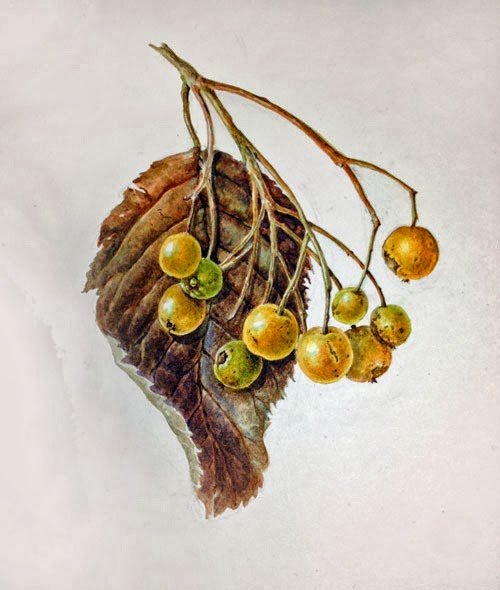
No. 21, 30 day Challenge, Whitebeam Berries, unfinished
An unexpected event yesterday resulted in a couple of trips to the hospital! so I'm a bit behind with everything today.
I collected this little piece of Whitebeam with unripe berries outside a nursing home in Stalybridge, Gt Manchester on Sunday morning. These berries turn bright red but I quite like them at this stage.
Unfortunately I completely ran out of time to paint it today and I'm too tired now .....so here it is unfinished..... That's just how it goes sometimes.
 At one time Whitebeam was an important timber in Britain, being a fairly hard wood it was used to make parts in machinery before being replaced by iron. It later became a much planted roadside tree. It's a lovely tree with a distinctive light downy underside on the unusual coloured leaves.
Colours: Berries, Gold Ochre and Green Gold graded wash depending on the level of green or yellow in each berry. Highlights were left clear. I applied 3 washes. Then some detail using Raw Umber and Burnt Umber. I added a little Sap Green on the darker greens Would have continued to build up a bit more form using some dry brush but no time to do so.
Leaf , Burnt Sienna and Gold Ochre for the initial wash, several washes were requires with some Green Gold added. I used Cerulean Blue on the highlights and Ultraviolet and Indanthrene blue on the shadows. I used the the Ultraviolet to the Burnt Sienna for the recesses at the veins. Needs more tone but again no time.
Stem: Incorporated many of the same colours, first green gold and Burnt Umber, Followed by a wash of Burnt sienna in the richer coloured stems and shade the same as the leaf.
I collected this little piece of Whitebeam with unripe berries outside a nursing home in Stalybridge, Gt Manchester on Sunday morning. These berries turn bright red but I quite like them at this stage.
Unfortunately I completely ran out of time to paint it today and I'm too tired now .....so here it is unfinished..... That's just how it goes sometimes.

Colours: Berries, Gold Ochre and Green Gold graded wash depending on the level of green or yellow in each berry. Highlights were left clear. I applied 3 washes. Then some detail using Raw Umber and Burnt Umber. I added a little Sap Green on the darker greens Would have continued to build up a bit more form using some dry brush but no time to do so.
Leaf , Burnt Sienna and Gold Ochre for the initial wash, several washes were requires with some Green Gold added. I used Cerulean Blue on the highlights and Ultraviolet and Indanthrene blue on the shadows. I used the the Ultraviolet to the Burnt Sienna for the recesses at the veins. Needs more tone but again no time.
Stem: Incorporated many of the same colours, first green gold and Burnt Umber, Followed by a wash of Burnt sienna in the richer coloured stems and shade the same as the leaf.
Monday, 23 September 2013
No. 20, 30 Day Challenge, British Plum
Three quarters of the way through the Challenge! .... and it's back to the fruit. So here's one of my favourites, a very ripe plum.
.
 I don't think I've ever painted one of these plums before and overworked it a bit.
Colours: First wash, Aureolin and Scarlet Lake, leaving the main highlights clear.
Second wash a more 'red' mix adding Permanent Carmine.
Add some detail with spots and a third wash of Transparent Yellow and Permanent Carmine, followed by some dry brush with Permanent Carmine and Neutral Tint.
A little Cobalt Violet was used on the reflected light.
Finally, to add the bloom, I used Chinese White and Cerulean Blue.
.

Colours: First wash, Aureolin and Scarlet Lake, leaving the main highlights clear.
Second wash a more 'red' mix adding Permanent Carmine.
Add some detail with spots and a third wash of Transparent Yellow and Permanent Carmine, followed by some dry brush with Permanent Carmine and Neutral Tint.
A little Cobalt Violet was used on the reflected light.
Finally, to add the bloom, I used Chinese White and Cerulean Blue.
Sunday, 22 September 2013
No. 19, 30 Day Challenge, Dead Rose no. 2 on vellum
Decided to try the another one of my three dead roses. Not so happy with this one it felt a bit rushed but I do love this natural vellum and want to paint more on it.
I enjoyed painting the first rose and though trying another was a good move, however it doesn't follow that the experience and outcome will be the same.

The colours are much the same as yesterdays, the piece of vellum is a little darker and more golden. There's not an awful lot more to write about this piece, other than to say that the weekend goes much faster than the weekdays and time feels very short.
Friday, 20 September 2013
No. 18, 30 Day Challenge, Dead Rose on vellum
After the rushed rosebuds yesterday, I wanted to spend a bit more time on today's painting so allowed about half a day. I have some natural vellum and wanted to try it out, it's a lovely honey colour, shame this photograph doesn't really show the colour but you can see the veins in the skin. Vellum paintings take a long time normally so I decided to paint using a very limited palette using some of the earth colours in my palette, almost like an under-painting.... not just because time was limited but also because it suited the subject for today's painting.
The subject is a dead rose that I've had since my birthday last year. It was originally white and formed part of a beautiful bouquet....a very special birthday gift! It always seems a shame that cut flowers fade so soon, so I kept a few and they live on the kitchen windowsill now.....as a keepsake and are just as appealing to the eye even in this decayed state.

Colours: Raw Umber, Burnt Sienna, Gold Ochre and a tiny amount of Sepia. I also used a very light wash of Cerulean in areas on the left side ( light side) of the flower, to lift it.
I applied a very light wash of raw umber and burnt sienna, with some gold ochere on the left side. first, then modelled the suface using the appropriate dry brush technique. I added the veins using a needlepoint brush which was from the The Brushman, David Jackson. Thank you David! wonderful brush.
The subject is a dead rose that I've had since my birthday last year. It was originally white and formed part of a beautiful bouquet....a very special birthday gift! It always seems a shame that cut flowers fade so soon, so I kept a few and they live on the kitchen windowsill now.....as a keepsake and are just as appealing to the eye even in this decayed state.

 |
| Detail of dead rose showing the venation pattern, the viens in the rose suit the vellum well! |
I applied a very light wash of raw umber and burnt sienna, with some gold ochere on the left side. first, then modelled the suface using the appropriate dry brush technique. I added the veins using a needlepoint brush which was from the The Brushman, David Jackson. Thank you David! wonderful brush.
Subscribe to:
Posts (Atom)

 Posts